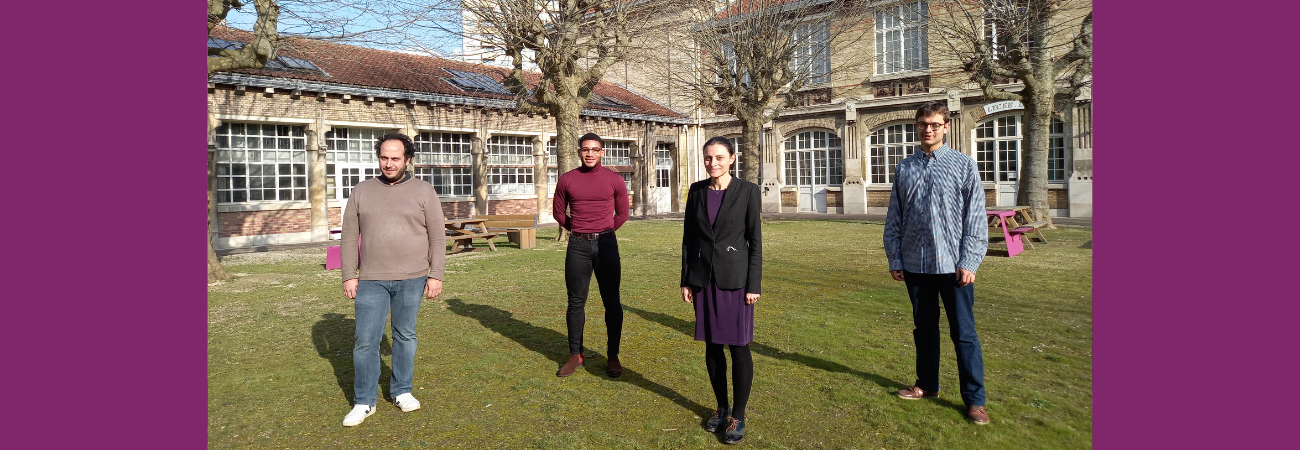
Start-up founded in late 2018 and incubated at Arts et Métiers early 2019, Geosophy develops software tools that facilitate the real estate development of underground spaces through geo-energy. It offers local, sustainable, renewable, and carbon-free energy for heating and cooling resilient buildings. We meet with the two founders: Quentin Barral and Alice Chougnet.
Could you introduce yourself?
We are two physicists who used to work in the oil industry, and we wanted to redirect our skills toward sustainable development, particularly in the field of geo-energy. After strengthening our knowledge of construction and real estate, the idea for Geosophy was born.
Our primary goal is to create a company committed to energy transition.
What sparked your interest in geoenergy?
You could call it a "search for meaning" or a "brownout" (or even a midlife crisis for one of us!), but our primary goal is to create a company committed to energy transition. By staying underground, we are making the most of our past experience.
What is the purpose of Geosophy?
We wanted to create this company to promote the use of geo-energy. Just like the Greek root of Geosophy, meaning "wisdom of the Earth," geo-energy is local, carbon-free, and neutral, allowing us to recover both heat and coolness from the ground. The two of us created this startup in 2018: it now has seven permanent employees and two to three interns.
We wanted to start this company to make geo-energy more widely used.
What does Geosophy do to achieve its objectives?
We started from the observation that most homeowners did not consider this technology because it seemed too complicated to them. That's why we developed the first basement search engine that, for a given address, quickly determines whether geo-energy is suitable, using technical and financial criteria. We support our customers right through to installation, using our technical expertise to produce detailed models and review the proposed solutions. In addition, we have patented technological tools that enable us to study each option so that the customer can make the best choice for their project, but also for the environment.
Can you tell us about one of your recent projects?
After focusing heavily on office buildings (we have scanned around a hundred buildings to date for institutional real estate companies), often in Paris or other large cities, we are currently working on an industrial building in Occitanie.
In this case, the primary objective is not to increase the property value of the building, but rather to demonstrate the sincerity of the owner's environmental approach and their long-term commitment to optimizing their energy bills.
Geo-energy can meet a variety of needs in very different contexts: it is time to catch up and, why not, overtake Sweden, where a quarter of buildings are now equipped with it.
What are your current targets and what would you like to develop in the coming years?
Today, we are primarily targeting real estate companies, because their business is real estate, and they have historically been leaders in the sector in adopting innovative practices. We also want to strengthen our impact on local authorities, because they are keen to accelerate the environmental transition, whether for their own buildings subject to the tertiary decree (town halls, schools, etc.) or those of companies located in their areas.
What does being incubated at Arts et Métiers mean Arts et Métiers a company like Geosophy?
This represents many things: wonderful encounters with other entrepreneurs, for starters; entrepreneurs; collaboration with the Dynfluid laboratory, which was very important for us, because without the help of this laboratory, it would have taken us much longer to develop our technological tools; access to financing at the start of our project; solidarity in the form of a temporary reduction in financial costs during the 2020 lockdown, when our cash flow was at its lowest; and finally, premises suited to our needs.
Without the help of the Dynfluid laboratoryArts et Métiers, it would have taken us much longer to develop our technological tools.