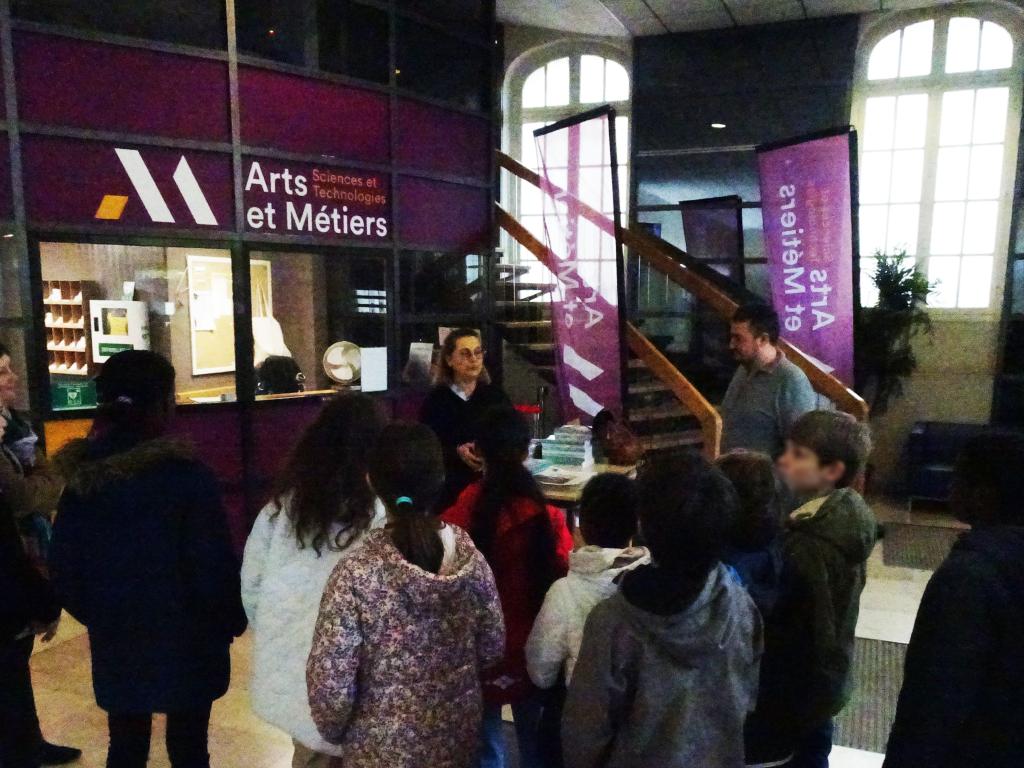

On the mornings of May 12 and 22, 2023, a group of second-year students from Grande Ecole Engineering Programme Aloyse Aubry, Edouard Bertho, Wafaa Moujallal, and Daniel Andres Tinoco Estrada) welcomed two fifth-grade classes from an elementary school in the 13th arrondissement to the Arts et Métiers campus Arts et Métiers Paris .
As part of the "Science at School" project supervised by Bénédicte Hayne and Marc Rébillat, these students carried out their "Career Project" on various topics:
- Archimedes' principle
- Hydrophobia phenomenon
- Gear systems (gears, lever arms, pulleys/hoists)
- Fundamentals of Electricity
Marc Rébillat, lecturer and researcher at the PIMM Laboratory, explains: "As part of their course, students have to work on a multidisciplinary group project, which they carry out independently and is supervised by various teachers. Bénédicte and I thought it would be interesting to present this project to primary school pupils, especially as the demonstrations carried out by the students enable them to improve their communication skills. "
And so, the second-year students begin by telling the fifth-gradersthe story of a fisherman who loved to spend whole days at sea catching fresh fish for his family... How can we help him make his fishing safer and more efficient?

The rest of the story in testimonials and images (with a short break to discover some 3D-printed objects with Guillaume Martin, Research Engineer at SDTools, a company hosted at PIMM)!

What does Edouard Bertho, a dual degree student with ESTP, think about this? "I enjoy sharing my experiences. When I was a child, I did a lot of experiments, and I think it's great that we can bring students to the school and give them more in-depth demonstrations thanks to our engineering training. With a young audience, we have to make an effort to use simpler words and find examples from everyday life."
And Wafaa Moujallal, a dual degree student with ENSAM Morocco?"Ever since I was little, I've been fascinated by experiments. I like to know how an engine works. I thought to myself, 'Why not show this to children?' The students were responsive and asked lots of questions. One group even asked to do a different experiment, and it worked. I think I could do it again for the other groups."
For the teacher of some of the fifth-grade students: "It's interesting to introduce children to science in a different way than the school method. Since we studied science, it's very rewarding to succeed in making children want to discover more. I hope they'll want to study engineering."