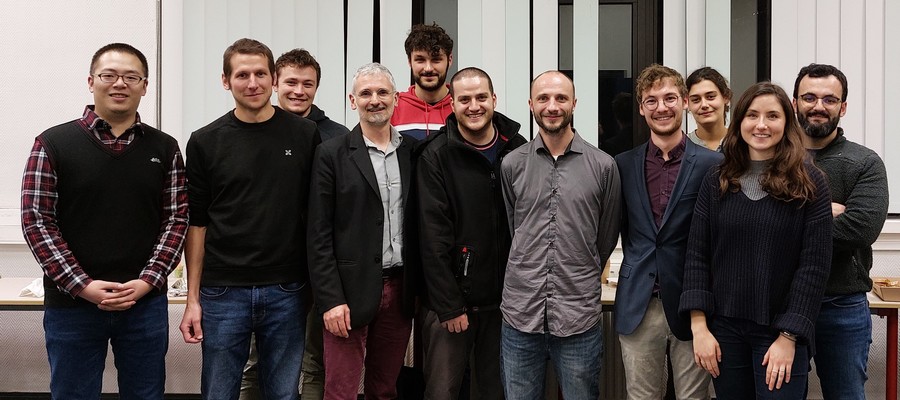
The partnership with Valeo is a prime example of how collaboration between an industrial company and research teams can benefit both parties!
"As part of the 'Nonlinear Dynamics for Future Automotive Transmissions' chair created with Valeo, we have conducted research at LISPEN on technical issues that have advanced our knowledge to the highest international level," emphasizes Olivier Thomas, Professor of Mechanics and System Dynamics at the Arts et Métiers campus Arts et Métiers Lille. We have already published a dozen articles and filed four patents directly related to the chair. At the same time, thanks to the results of our research, which were quickly industrialized, Valeo has gained competitive advantages and new market share."
Valeo honored thanks toArts et Métiers theses
The industrial chair created in 2018 focuses on noise and vibration control in the automotive powertrains of the future. This theme has given rise to five theses, one of which is currently in progress.
Two of these theses, written by Alexandre Renault and Vincent Mahé, even enabled Valeo to industrialize an innovative pendulum damping system and receive an Automotive News Pace Award in 2022. This prestigious award recognizes automotive suppliers for their innovations, technological advances, and commercial performance.
The first focused on "Calculation and optimization of pendulum absorbers in an automotive powertrain." The aim was to develop efficient and rapid calculation methods that would provide engineers with tools to reduce vibrations in pendulum absorbers.
The second focused on vibration problems in electric motors and proposed two new absorber architectures: one that uses a nonlinear mechanism to double the operating frequency, and the second based on a double pendulum.
At the same time, another thesis (by Eddy Abboud) studied how to reduce transmission noise and explained a number of vibration phenomena observed in gears in a different way, while providing Valeo with new methods for calculating vibrations and acoustics.
Intelligent systems to reduce vibrations
In parallel with work on these mechanical pendulum absorbers, strategies for replacing them with electronic circuits are also being studied. Michel Auleley's thesis on "The Design and Calculation of Semi-Active Vibration Dampers for Automotive Powertrains" provided the first proof of concept for this work. This work is currently being continued in Guillaume Hay's thesis, "Semi-active vibration control for automotive electric transmissions," which aims to provide Valeo with an even more effective vibration reduction device that is better suited to the constraints of today's electric motors.
"The goal today is to reduce the vibro-acoustics of electric machines," emphasizes Olivier Thomas.
The partnership with Valeo is therefore set to continue for several more years!
One team, many projects
- OVMI (Flying Object Mimicking Insects) project: design of a nano drone with vibrating wings (ANR ASTRID, Hauts-de-France region, IEMN Lille/Valenciennes)
- THREAD project: simulation of highly flexible structures (European Training Network (ETN) project)
- Vibroacoustic hearing protection project (CifreCOTRAL-Lab thesis)
- HYDRAVIB project: reduction of ship hydrofoil vibrations using piezoelectric devices (ANR ASTRID, DGA, IC CARNOT ARTS, Cnam-LMSSC, Naval Academy)
- Project for recovering vibrational energy using nonlinear piezoelectric devices (AMVALOR, Hauts-de-France region)