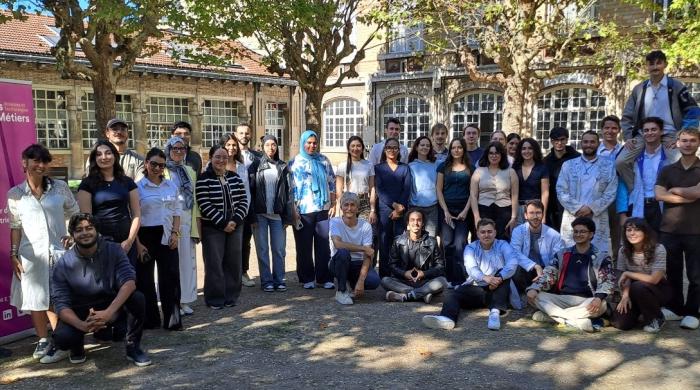

"I am fortunate to be able to apply my personal beliefs in the professional environment."
Tom Bauer has developed a personal and professional commitment to the environment. Since September 2021, Tom has been a lecturer and researcher in environmental assessment and end-of-use and end-of-life strategies for products in Chambéry.
Where does your commitment to the environment come from?
My higher education focused heavily on mechanical and industrial engineering, but I’ve always wanted to use my skills to contribute to a “better environment.” After two years at the IUT in Besançon and a year on the ERASMUS program in Ireland, I decided to Master of Science a Master of Science in eco-design.
When tackling this subject, I feel that the deeper you dig, the more you realize the problems exist, which motivates you all the more to find solutions!
I then joined theG-SCOPlaboratory in Grenoble as a research engineer. It was there that I became interested in environmental issues related to services,such as the functional economy.
I then completed my thesis, also at G-SCOP, on design challenges related to the end of a battery’s useful life: how to find cascading applications for industrial products to enable successive uses and maximize their lifespan and functionality, thereby minimizing their environmental impacts.
I am fortunate to be able to apply my personal convictions in the professional world.
What are your teaching topics?
In my training activities, I provide students with tools for environmental assessment and knowledge of environmental issues, particularly those related to complex products such as digital products. What are the "hidden" impacts of digital technology? What design approach should be taken for end-of-use and end-of-life: a recycling or remanufacturing strategy, i.e., reintroducing a product at the end of its life or end of use into the industrial chain, re-inspecting it, and offering it for sale as equivalent to a new product.
What are your thoughts on students' attitudes toward environmental issues?
I find our students to be genuinely interested and interesting, motivated, knowledgeable, and critical. They also don't hesitate to contribute ideas and challenge us. It's very encouraging!
What about research?
The themes are similar. I am co-supervising Axelle Bertrand in her thesis work aimed at massifying LCA (Life Cycle Assessment) to account for the environmental impacts of as many consumer products as possible. Coupled with this, we are questioning the associated environmental labeling: how can we better represent the information for consumers?
As part of Marion Ficher's thesis, we are looking at issues related to the end of life of digital electrical and electronic equipment (all objects connected to the internet). What will happen to them, how can we obtain reliable information, what are the official and unofficial end-of-life channels, and what are the environmental impacts?
Mathis Cuzin's thesis has just begun on the development of a "sustainable" PLM. PLM is software that manages a product throughout its life cycle, used in factories for, among other things, reference management, inventory management, and product management. The goal is to integrate environmental and social dimensions into it.
At the same time, I participated in a module of the PIA3ET-LIOSproject aimed at integrating sustainability issues into engineering. The goal is to train trainers. We have set up course modules on these issues of socio-technical and environmental transition to help teachers learn these concepts (LCA, low-tech, critical materials, eco-design, eco-innovation, etc.). It is freely accessible to higher education teachers.
I am also participating in the SDC2 project: Smart Disassembly Cell for Circularity. Led by colleagues at I2M in Bordeaux, its objective is to set up a semi-automated disassembly line to make the best use of end-of-life products. The products must be identified, tested, disassembled, and the various sub-assemblies qualified for further disassembly, recycling, repair, or reuse for another application. Initially, this will involve electric motors, power converters, and large electrical and electronic equipment such as washing machines.
How does the research activity of the Chambéry institute contribute to the fight against the environmental impacts of products and services?
We are looking for ways to extend the lifespan and added value of products in order to minimize their impact through strategies that focus on enhancing their functions rather than just their materials.
We feed information back to designers and/or decision-makers using various indicators based on field data to support them and enable them to innovate with the aim of reducing environmental impact.
We are also working on extending the lifespan of products through strategies for reusing parts and components.
What do you think of the institution's environmental policy?
This is a step in the right direction. I would like to be able to speed things up. In my opinion, this starts with training colleagues on the challenges of the transition that is underway. This echoes our work at ET-LIOS, but also the school's many initiatives at both the national (Axis 2) and local (think tanks in Aix and Châlons) levels. We need to be able to organize ourselves as best we can and free up time for all of this.
At the same time, we need to be able to dedicate certain courses to these specific issues. This is what we are able to do in Chambéry.