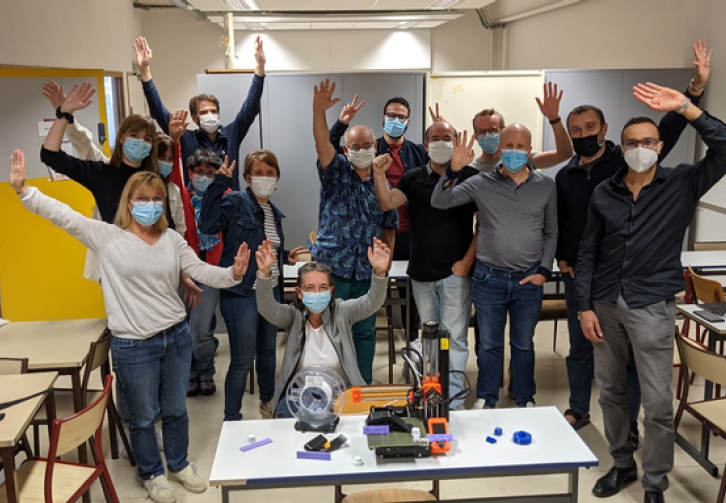
Arts et Métiers, University College Dublin (UCD/Ireland), the University of Tartu (Estonia), and the Irish company Stryker are joining forces to raise awareness among young people about the industry of the future by inviting primary school children to take part in creative additive manufacturing experiments dedicated to health and well-being. The initiative is funded by EIT Manufacturing, an organization that aims to bring together European industrial players in the manufacturing industry.
A challenge combining creativity and communication
Organized as part of AM4 Healthy Future, a European program designed to train teachers and their students in additive manufacturing, the competition, led by Arts et Métiers, aims to raise awareness among primary school students in three European countries (France, Estonia, and Ireland) about the impact of innovative technologies on improving our well-being. Children are invited to design and manufacture objects using 3D printing that improve their health and well-being or that of a member of their community.
The challenge for each class is to make a video of no more than three minutes showing their CAD (computer-aided design) work on TinkerCad software and the 3D printing process.
There are two categories:
- best design: entries will be judged on creativity, technology, and functionality,
- Best learning journey: the criteria are communication (form and content of the video), tenacity (obstacles overcome), and involvement (research conducted, potential users approached).
The competition will first take place in each participating country, then at the European level. A national awards ceremony and the European grand final will be held on December 17, 2021.
The overall winners from each country will return to their schools with a 3D-printed trophy and a certificate. Each participating student will also receive a small 3D-printed object as a souvenir of their work.
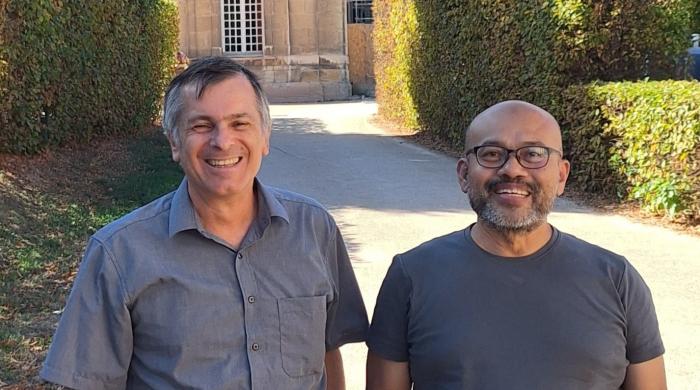
"This challenge is a way to raise awareness of technology among young people, reaching both girls and boys from all social backgrounds," " says Imade Koutiri, head of FabLab and third-year Additive Manufacturing expert at the PIMM (Processes and Engineering in Mechanics and Materials) laboratory, accompanied by Xavier Bonnet from the Georges Charpak Institute of Human BiomechanicsArts et Métiers, both of whom are in charge of organizing the challenge.
This challenge is a way to raise awareness of technology among young people, reaching both girls and boys from all social backgrounds.
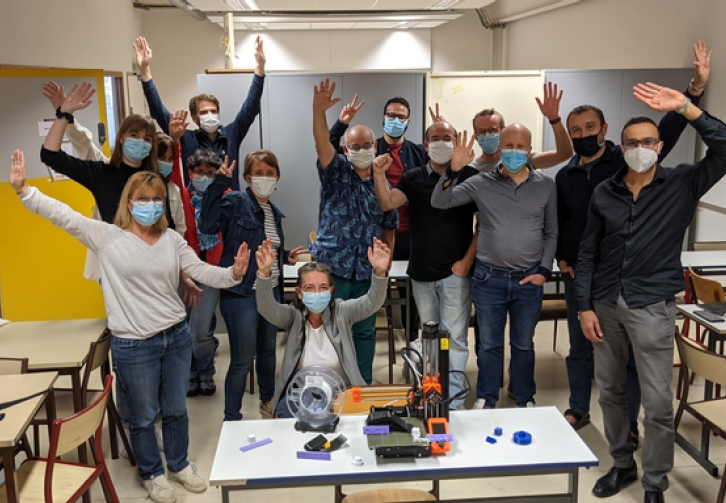
Train teachers in 3D printing and CAD
Around fifty volunteer teachers took part in training on 3D design so that they could participate in the challenge. The training took place in the three participating countries (France, Ireland, and Estonia) over two days: one day of training in CAD (computer-aided design) and one day of training in 3D printing.
The trainers then supported the teachers throughout the challenge, answering any questions they had.
3D printers were then loaned to the various participating classes. Some local authorities also got involved and financed the purchase of machines for the schools involved.
"In France, we worked with the town halls of the 13th arrondissement of Paris and Bourg-la-Reine (92), which were very responsive and dynamic, as well as with schools in Villemomble (93), Eragny (95), Stains (93), Meaux (77), and Aulnay-sous-Bois (93)," explains Imade Koutiri.
A cooperation project between European countries
The various phases of the AM Healthy 4 Future project, organized as part of EIT Manufacturing, were divided between the three participating countries. The project was initially led by the Irish company Stryker, one of the world's leading medical technology companies. The University of Dublin was tasked with setting up the teacher training program. The University of Tartu was responsible for rolling out the program, while Arts et Métiers designing and implementing the Healthy Future Challenge.
"This challenge was an opportunity to work with teachers who were very enthusiastic and motivated," says Imade Koutiri. "It was also an opportunity to see how a European project works and to forge relationships with new partners. In fact, we already have another project in the pipeline with University College Dublin!"