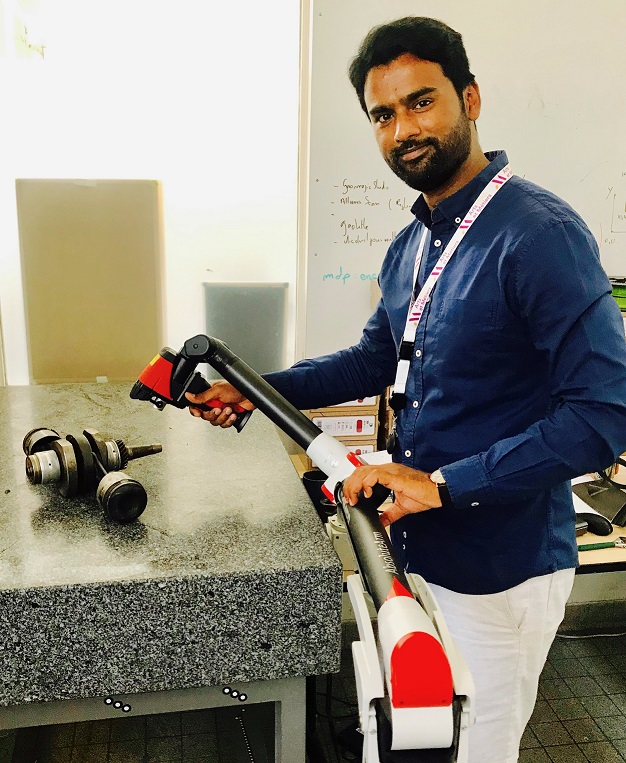
Ghazanfar Ali SHAH, PhD student at Lispen, will defend his thesis entitled "Template-based reverse engineering of parametric CAD models from point clouds" on July 1, 2021 (lecture hall M001).
Supervised by Jean-Philippe Pernot and Arnaud Polette, this thesis was carried out in collaboration with the Italian laboratory IMATI-CNR (University of Genoa).
Thesis title:
Reverse engineering of parametric CAD models from point clouds using templates
Summary:
Although many reverse engineering techniques exist for reconstructing real objects in 3D, very few are capable of directly and efficiently handling the reconstruction of editable CAD models of mechanical part assemblies that can be used in product development process (PDP) stages.
In the absence of suitable segmentation tools, these approaches have difficulty identifying the different parts that make up the assembly in the reconstructed model.
This thesis aims to develop a new reverse engineering technique for reconstructing editable CAD models. Its originality lies in the use of a calibration process based on the simulated recruitment optimization algorithm and utilizing two-level filtering capable of capturing and managing the boundaries of part geometries within the global point cloud.
This approach thus enables the detection of interfaces and the local adjustment of a part model to the point cloud.
The proposed method uses different types of data (e.g., point clouds, CAD models that may be stored in a database with the best associated parameter configurations for the calibration process). The approach is modular and incorporates sensitivity analysis to characterize the impact of variations in CAD model parameters on the evolution of the deviation between the CAD model itself and the point cloud to be calibrated.
The proposed approach is evaluated using both real scanned point clouds and virtually generated point clouds, which include several artifacts that may appear with a real scanner. The results cover several application scenarios related to Industry 4.0, ranging from the global adjustment of a single part to the updating of a complete digital model incorporating assembly constraints.
The proposed approach is particularly well suited to helping maintain consistency between a product/system and its digital twin.
Thesis jury:
Mr. Nabil ANWER Professor, LURPA, Paris-Sud University Examiner
Mr. Giovanni BERSELLI Professor, DIME, Università degli studi di Genova Examiner
Ms. Caterina RIZZI Professor, DIGIP, Università degli Studi di Bergamo Reviewer
Mr. Jean-Luc MARI Professor, LIS, Aix-Marseille University Reviewer
Mr. Jean-Philippe PERNOT Professor, LISPEN, Arts et Métiers
Mr. Arnaud POLETTE Ass. Professor, LISPEN, Arts et Métiers
Ms. Franca GIANNINI Research director, IMATI-CNR Genova Examiner
Ms. Marina MONTI Senior researcher, IMATI-CNR Genova Examiner
Keywords:
Reverse engineering, 2D and 3D calibration, simulated annealing, digital twin, Industry 4.0, sensitivity analysis, CAD model parameters, scanned point clouds, segmentation.