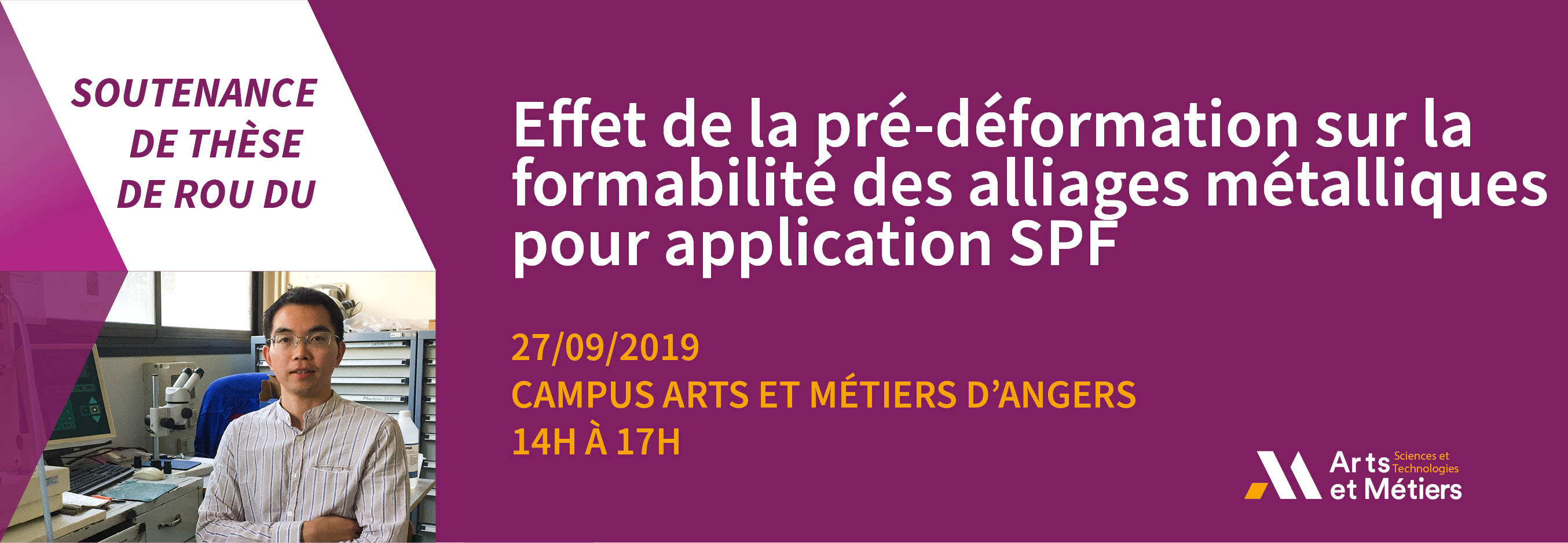
Lampa, a laboratory located on the Arts et Métiers campus Arts et Métiers , invites you to attend Rou DU's thesis defense entitled "Effect of pre-deformation on the formability of metal alloys for SPF applications: experimental and numerical approaches" on Friday, September 27, in Angers.
Thesis topic
Aluminum alloys have been widely used in the automotive and marine industries due to their advantages of low density and good corrosion resistance. The work presented in this thesis focuses on the hot forming of thin AA5383 aluminum alloy sheets. The main objective is to reduce forming time without sacrificing the integrity of the part. First, the hot deformation behavior of the AA5383 alloy is characterized experimentally.
An experimental campaign comprising uniaxial tensile, notched tensile, shear, and free swelling tests is carried out to cover a wide range of temperatures (623–723 K) and strain rates (10^(−4)–10^(−1) s^(−1)). Next, material models, such as a composite flow rule with the BBC2003 plasticity criterion and the Modified Mohr Coulomb damage criterion, were developed and implemented in ABAQUS using the user subroutine. Finally, numerical simulations of the gas formation processes were performed and compared with the corresponding experimental results.
Composition of the jury
- Sandrine THUILLIER, University Professor,IRDL - Rapporteur
- Abel CHEROUAT, University Professor, Charles Delaunay Institute - Rapporteur
- Anne Marie HABRACKEN, Director of Research, ArGEnCo - Examiner
- Arnaud DELAMEZIERE, Professor, LEMTA - Examiner
- Yessine AYED, Associate Professor, LAMPA - Examiner
- Charles MAREAU, Senior Lecturer, LAMPA - Examiner
- Philippe DAL SANTO, University Professor, LAMPA- Examiner
PRACTICAL INFORMATION
Arts et Métiers Campus in Arts et Métiers
2 Boulevard du Ronceray, 49000 Angers, France
From 2 p.m. to 5 p.m.
Abstract of the thesis (English version):
Aluminum alloys have been extensively used in the automotive and marine industry due to the advantages of low density, high strength to weight ratio, and good corrosion resistance. The major challenge of their application lies in the ability to form deep-drawing shapes. Superplastic forming is widely used to produce this type of part. However, high forming cycle times due to low forming strain rates limit their widespread application. This dissertation focuses on hot forming strategies for producing deep-drawn parts from AA5383 aluminum thin sheets. The main objective is to reduce the forming time without sacrificing the part integrity. Firstly, the hot deformation behavior of the AA5383 alloy is experimentally characterized. An experimental campaign, including uniaxial tension, notched tension, shear, and free bulging tests, is performed to cover an important range of temperatures (623~723 K) and strain rates (10-4~10-1 s-1). Then, the material models, such as a composite flow rule with the BBC2003 anisotropic yield criterion and the modified Mohr-Coulomb damage criterion, are developed and implemented in ABAQUS by using user subroutine. Finally, the numerical simulations of the gas forming processes are performed and compared with the corresponding experimental results.