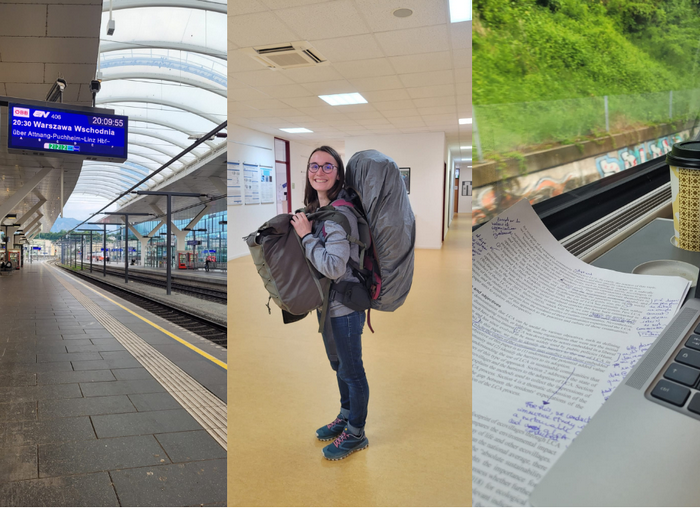
Lou Grimal, a teacher-researcher at the Chambéry Institute, often has to travel abroad. She is considering ways to limit the environmental impact of her trips.
What business trips abroad have you taken recently?
I mainly travel for European alliances or international conferences.
In recent months, I have had to make two business trips abroad. The first was to Warsaw in May for a meeting of the European ENHANCE alliance. The second was to Valletta (Malta) for an international conference of the Design Society in September.
A few years ago, I decided to stop flying for my travels. I found it contradictory to work on sustainability issues and teach about planetary boundaries while having a professional practice with a significant environmental impact. I still travel abroad, but I use slower modes of transportation!
What are the positive aspects of this choice?
Traveling by train allows me to turn every trip into an opportunity: I take advantage of it to see colleagues on my journey or plan vacations. For example, in 2021, I traveled by train to Stockholm for a conference. I stopped off in Darmstadt, Germany, to attend a scientific seminar with colleagues from Hochschule Darmstadt. It's a real bonus: I optimize my trips while maintaining human connections with international partners, which enriches my work.
What's more, being "stuck" on a train for a long time is also an opportunity to disconnect from my emails and work on scientific articles!
I would also like to thank the staff of the missions department for their support. It takes me about two days to cross Europe, and I appreciated their help in organizing these sometimes complex trips.
What about the negative aspects?
I often regret how short the assignments are compared to the travel time. I would like to stay at least a week on site to better interact with colleagues I rarely see and deepen collaborations!
But this one- to two-day journey time encourages me to demand higher-quality exchanges: rigorous preparation, active contributions, and advance work from everyone. Conversely, some colleagues, who arrive by plane in a matter of hours, sometimes approach these meetings with less preparation.
This contrast causes me some frustration because my logistical and time investment is much greater. I think that in the long run, this will lead me to refuse to travel for meetings that only last a few hours.
Will you continue this type of travel?
I do plan to continue these "low-carbon" journeys and to be more selective about the conferences and meetings I attend.
As for trips outside Europe, they require much more preparation and a solid scientific project, so for now, I'm putting that off for later!