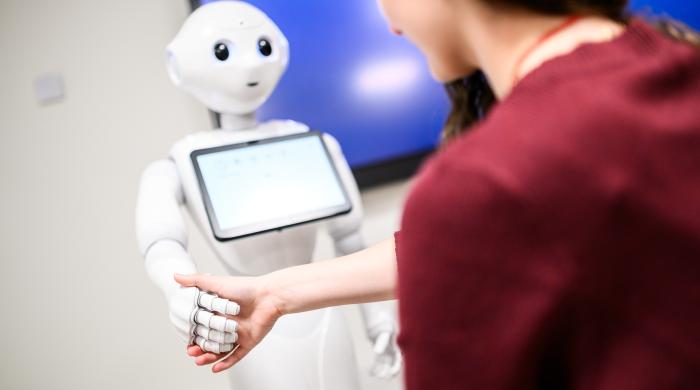

A lecturer and researcher at Arts et Métiers a doctoral student studying the acceptability of intelligent agents, Magali Gourlay-Bertrand explores the ethical, regulatory, and societal issues related to the integration of AI within the CAIRE project.
Can you introduce yourself in a few words and explain your role in the CAIRE project?
 My name is Magali Gourlay-Bertrand, and I have been teaching management sciences at the École Nationale SupérieureArts et Métiers ENSAM) on the Angers campus for five years now.
As part of the CAIRE project, I am particularly interested in the regulatory and ethical aspects of integrating AI systems, particularly in professional environments. My role involves analyzing the frameworks of responsibility, regulation, and governance associated with these technologies, as well as identifying the biases and concrete ethical issues raised by their deployment.
My particular legitimacy on these issues stems from the fact that I am currently in my third and final year of doctoral studies, focusing on the acceptability of contemporary intelligent agents in organizations—a thesis conducted at the LIRSA (Cnam Paris) laboratories, under the supervision of Cécile Dejoux and LAMPA (Arts et Métiers Angers Laval), under the supervision of Simon Richir and Sylvain Fleury. This work allows me to articulate academic research issues with concrete questions of integration.
What particularly motivates you about this project?
What motivates me about the CAIRE project is the opportunity to combine technical and societal approaches to think about AI in ways other than simply as a technological innovation.
I see this as a wonderful opportunity to fuel our collective thinking on how these systems should be designed and integrated in a responsible manner.
Any resources you would recommend on AI?
With this in mind, I am naturally drawn to works that place technology within the context of power dynamics: Cyberpunk by Asma Mhalla (2025), for its techno-political and geostrategic perspective on digital infrastructure and AI, in line with the author's thinking on Big Tech/Big States; The Age of Surveillance Capitalism by Shoshana Zuboff (2019), a beautiful work that provides an in-depth analysis of the societal problems of an economy based on data exploitation and the logic of large platforms. Giuliano Da Empoli's The Engineers of Chaos (2019) (the author has also just released The Hour of the Predators, which I haven't read yet, but it's on my list!).
These are useful references for gaining a better understanding of the strategies of political and social influence that rely on digital technologies, in a particularly worrying context. These works remind us that AI reflects and amplifies the power structures within which it operates. It is not just a question of mastering an innovation, but of consciously and collectively deciding which areas we want to open up to it and which we need to preserve.