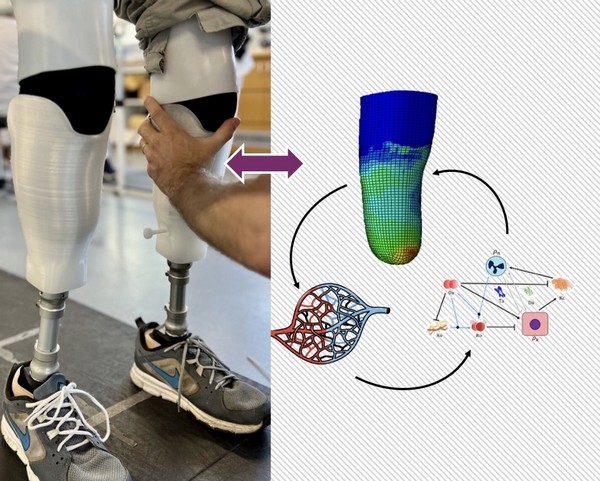
Detecting soft tissue injuries earlier thanks to digital twins is the goal of the TWIN-IT project, which is working to develop more predictive and personalized health engineering.
Predicting tissue damage using digital technology
How can we better understand and anticipate damage to soft tissues when they interact with medical devices? This is the question addressed by the TWIN-IT project, led by Arts et Métiers part of the France 2030 PEPR (Priority Research Programs and Equipment) program.
"The goal is to develop a digital twin customized for each individual, capable of early detection of soft tissue lesions," explains Pierre-Yves Rohan, professor at IBHGC and project leader for Arts et Métiers.
Designed as a continuation of several doctoral projects conducted at the laboratory, TWIN-IT aims to take digital twins in healthcare to the next level by explicitly integrating mechanobiological mechanisms, i.e., the link between mechanical stress and biological responses in tissues.
From the cell to the individual
One of TWIN-IT's major contributions lies in its multi-scale approach. "The challenge is to understand how forces are transmitted at all levels, down to microcirculation, in order to explain the mechanisms of damage," emphasizes Pierre-Yves Rohan.
The project relies on a combination of experimental approaches and modeling. Tests on biopsies taken from post-mortem samples will enable analysis of tissue damage at the microscopic level. This work will be supplemented by animal experiments, conducted in collaboration with biology laboratories, in order to test and validate the mechanobiological hypotheses developed.
Finally, experiments on amputees will feed into personalized biomechanical models. "We will combine experimental measurements at the skin-device interface with models capable of estimating tissue viability," explains the researcher. Ultimately, the goal is to have a monitoring tool capable of providing real-time feedback.
Clinical and industrial applications
While TWIN-IT is fully committed to fundamental research, its potential benefits are clearly identified. "The issues concern prostheses, orthoses, exoskeletons, and even wheelchairs—anywhere a device interacts mechanically with the body," Pierre-Yves Rohan points out.
The project aims to make these devices safer for patients, while providing design tools for healthcare professionals, particularly orthopedic technicians. "Today, fitting remains a very artisanal process, involving a lot of trial and error. Digital technology can help reduce these iterations, material losses and, ultimately, waste," he explains.
Beyond clinical issues, TWIN-IT fully echoes the dynamics promoted by the AM Santé program: "It is a powerful lever, both for research and for teaching and developing new skills in health engineering," concludes Pierre-Yves Rohan.
About the TWIN-IT project
Funded as part of the France 2030 PEPR program, the TWIN-IT project will begin in April 2026 and run for four years.
With a total budget of around €1.5 million, it brings together a large academic, clinical, and industrial consortium, coordinated by Arts et Métiers. The project involves teams from the CNRS, Mines Paris-PSL, biology laboratories, and clinical partners, as well as the company Proteor. It plans to recruit several doctoral students and research engineers.