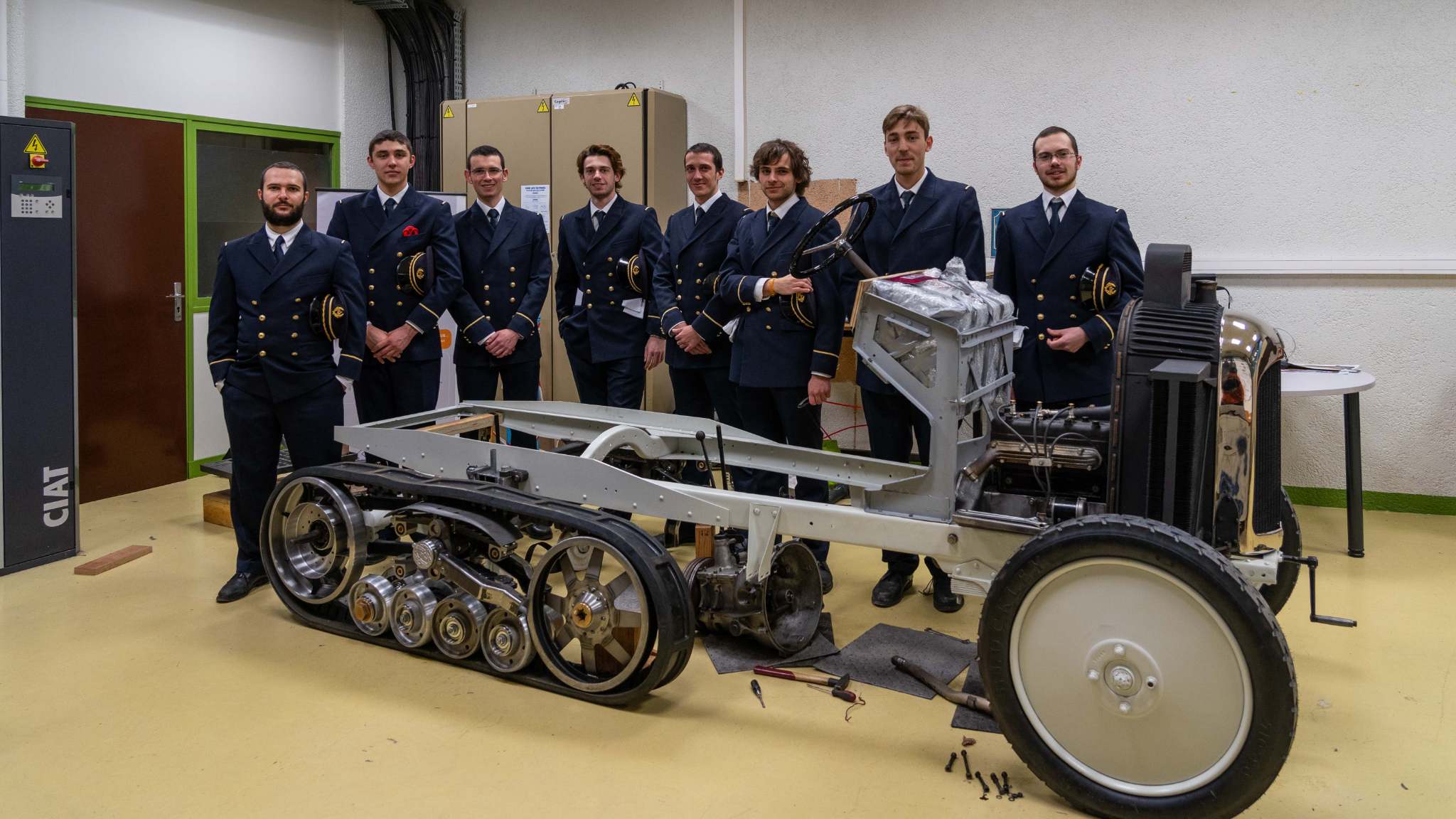
Arts et Métiers students Arts et Métiers competing to win the 40th Automobile Magazine trophy. Their project: rebuilding the Citroën half-track vehicle that crossed the Sahara during the Croisière Noire expedition in 1924-1925.
2019, an anniversary for Citroën
As part of Citroën's 100th anniversary celebrations in 2019, the Des Voitures & des Hommes association aims to build an identical replica of the Citroën B2 (model K1) half-track vehicle known as the Scarabée d'Or, which, along with four other vehicles, made the first crossing of the Sahara. To this end, in 2017 the association called on Arts et Métiers the Château d'Epluches vocational school for automotive and transport trades in Saint Ouen l'Aumône. Arts et Métiers in charge of the mechanics of the tracks, while the vocational school is responsible for the bodywork.
The project has been selected this year to compete for the Automobile Magazine trophy (more information), with voting open until January 31, 2019, at 12 p.m.
A renovation marked by training
Three campuses, Cluny, Angers, and Metz, and one institute, Chalon-sur-Saône, participated in the project. No fewer than fifty second-year students were mobilized to carry out the dismantling and measurement. To do this, they machined the drive wheel cam, cast the roller support shaft at the foundry, and bent and rolled the idler wheel using plastic deformation. As the vehicle's plans had been destroyed, the students revisited an old entrance exam test that involved sketching technical parts using wash drawing.
The Scarabée d'Or project will also enable the vocational high school specializing in automotive and transportation trades to offer a complementary teaching module on the maintenance and restoration of historic vehicles.
A virtual clone of the caterpillar track
The project also benefited from virtual and augmented reality technologies developed by the Institut Image in Chalon-sur-Saône. Students studying Interactive 3D Technology Management at the Institut Image combed through the parts and bodywork of the half-track using a laser scanner. Their mission was to create a working virtual reality demonstrator. In other words, an application in which a virtual clone of the Golden Scarab will be immersed in a virtual environment. A journey through time that will take the Golden Scarab back to the Sahara in 1924.
Like a project review in aeronautics, the vehicle's mechanism can be animated, dissected, and projected from new angles.