After a test phase, the CAIRE project is entering a new phase. The goal is to broaden the audience trained in artificial intelligence, while ensuring the quality and modularity of the program.
A positive initial assessment
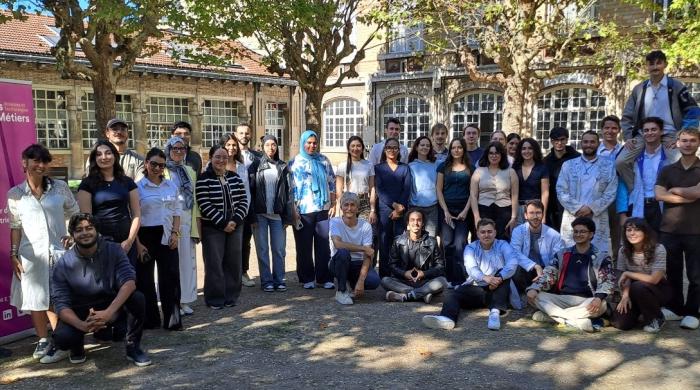
Since November 2024, the CAIRE (Citizen-oriented Artificial Intelligence training for a Responsible Education) project has trained 121Arts et Métiers staff members, well above the initial target of 80. These sessions took place on three campuses (Paris, Aix-en-Provence, and Bordeaux) and involved administrative and technical staff as well as teachers. Another session is planned for June in Châlons-en-Champagne. At the same time, 95 students have already tested the level 1 training.Arts et Métiers also achieved its goal of training 10 staff members internally to deliver the training. This momentum will enable staff and students to be trained in AI and its various models, which will be used in the ELFs.
"I would like to thank the educational engineers and experts involved in designing and producing the training courses, the trainers already engaged in rolling out the project, and all the departments involved in implementing the training courses and developing CAIRE's visibility," emphasizes Cécile Weltman, project manager.
A project coordinated by Arts et Métiers
CAIRE aims to establish a sustainable and widespread approach to training citizens in the use of artificial intelligence. Winner of France 2030's call for expressions of interest in Skills and Jobs of the Future, the project began in September 2023 and will run for five years. It is coordinated by Arts et Métiers brings together CESI, Cnam, the University of Burgundy Europe, and the Paris School of Business.
Feedback from learners and trainers
Also tested in three consortium institutions (CESI, Université Bourgogne Europe, and Paris School of Business), Level 1 of the training was completed by a total of 1,385 students, 87 staff members, and 35 trainers. It is currently being improved based on feedback from learners and trainers. The goal? To make distance learning content more accessible and concrete, and to offer a catalog of in-person activities that can be adapted to different audiences and contexts.
The new version of Level 1 is expected at the end of June 2025.
Towards the deployment of Level 2
Level 2, which focuses on professional uses of AI, includes more practical cases and independent work. It will be tested starting in the summer of 2025, with a gradual ramp-up. As Cécile Weltman explains, "The goal is to test Level 2 with a small panel before rolling it out more widely in 2025-2026."
At the same time, Level 3 will begin to be defined by the end of 2025 to build "a comprehensive and progressive training program, from awareness to expertise."
Sessions were also held outside the academic world, notably with 32 employees of Dijon Métropole who benefited from training via the University of Burgundy Europe.
The challenges of the coming months
The immediate priority is to roll out Level 1 on a larger scale. The aim is to reach new audiences and strengthen the integration of training into existing curricula. The introduction of an associated certification will enable the skills acquired to be officially recognized.
Marketing for the program will begin at the start of the 2025 academic year, targeting public and private partners.
CAIRE joins the AI Alliance
The CAIRE project is now part of the AI Alliance, a national initiative launched at the Summit for Action on AI. This unique alliance brings together 11 higher education institutions alongside Mistral AI and French EdTech startups.
Thanks to this collaboration, CAIRE is part of an ambitious initiative to promote artificial intelligence for learning, in line with European values of equality, frugality, and transparency. The Bourgogne-Franche-Comté region and Compar:IA are also joining the project as partners.