Guillaume is a student in the Specialized Master's Program® - Drone Solution Designer: Innovative Uses and Technologies, at the Arts et Métiers campus Arts et Métiers .
An engineer who graduated from École Centrale Paris, he quickly gravitated toward mechanical design, choosing to further his studies in mechanics during his time at university with a dual degree in mechanical engineering in Spain.
High value-added training
At 33 years old and with 10 years of experience in the design, development, and qualification of cutting-edge mechanical systems, Guillaume wants to move into the architecture and creation of innovative products and services based on drone technologies, particularly for high value-added professional civilian applications. A Specialized Master's Degree enjoys a high profile and recognition in his sector of activity or in his professional environment.
Guillaume explains: "A Specialized Master's® seems to me to be a good compromise for effectively acquiring new knowledge and skills during my professional career; its duration is short enough to be completed as part of professional training."
Training that matches your career plans
The program lasts one year. The curriculum is divided into two main parts: an academic semester on campus and an industrial semester spent on a professional assignment in a company.
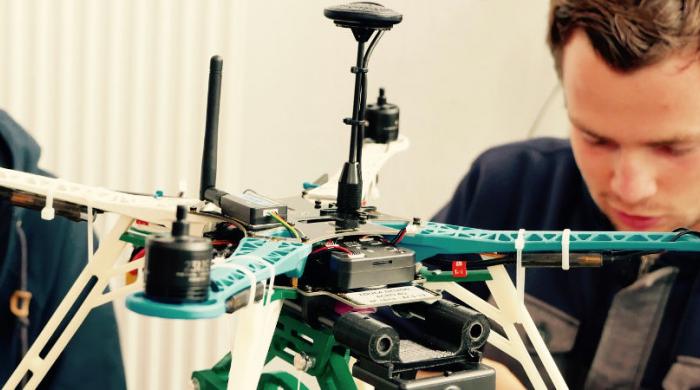
The academic semester includes traditional thematic teaching modules, as well as a project to create a drone solution.
A comprehensive training program that is virtually unprecedented in France.
It offers a real opportunity to acquire recognized skills and expertise in a rapidly expanding field, where the majority of applications (hardware and related services) are still likely to be created and developed. This Specialized Master's degree combines theoretical teaching with practical experience (including a project to create a drone solution). Guillaume considers this complementarity to be important for the evolution from a fairly conceptual activity (mechanical design) to a more practical activity (innovative application architecture).
Learning through passionate design.
The training course ends with the completion of a team-based educational project, based on design-based learning, from needs analysis to implementation.
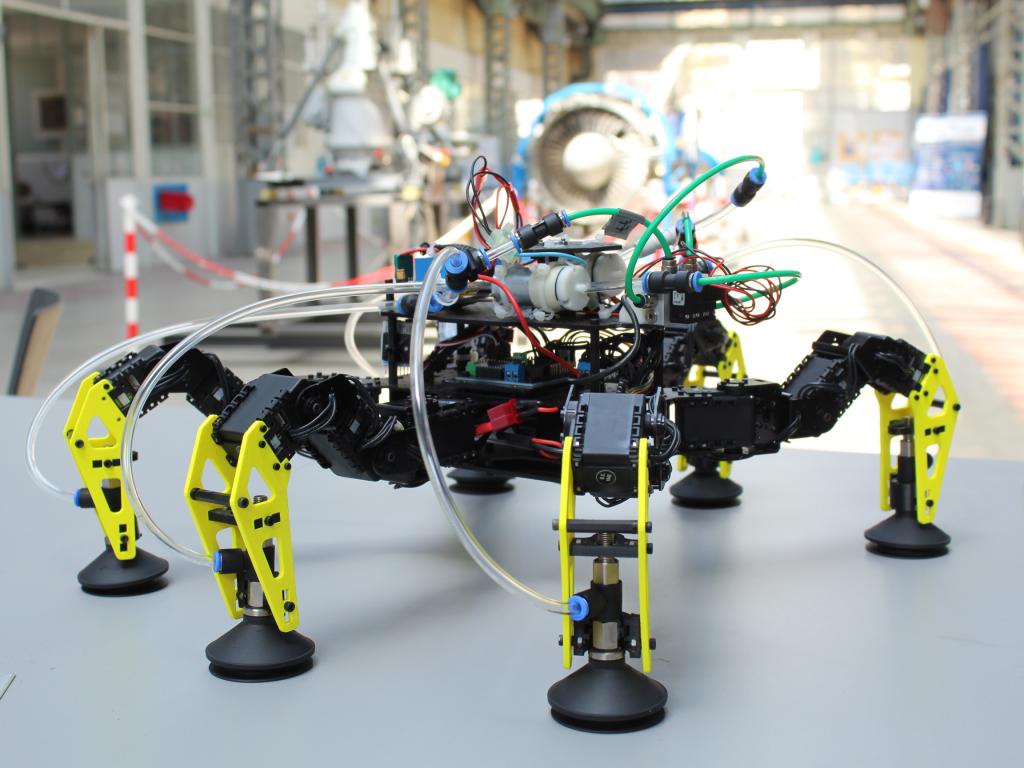
Guillaume and his team chose to design a climbing drone for inspecting structures. The drone must be able to move and maintain itself autonomously on a 3-dimensional structure (such as an airplane fuselage, including "on the ceiling") to perform inspection tasks and/or small interventions (riveting, screwing, etc.).
After analyzing the specifications and constraints, they decided to use a commercial platform as the basis for developing their solution.
Making the subject exciting. The stakes are high.
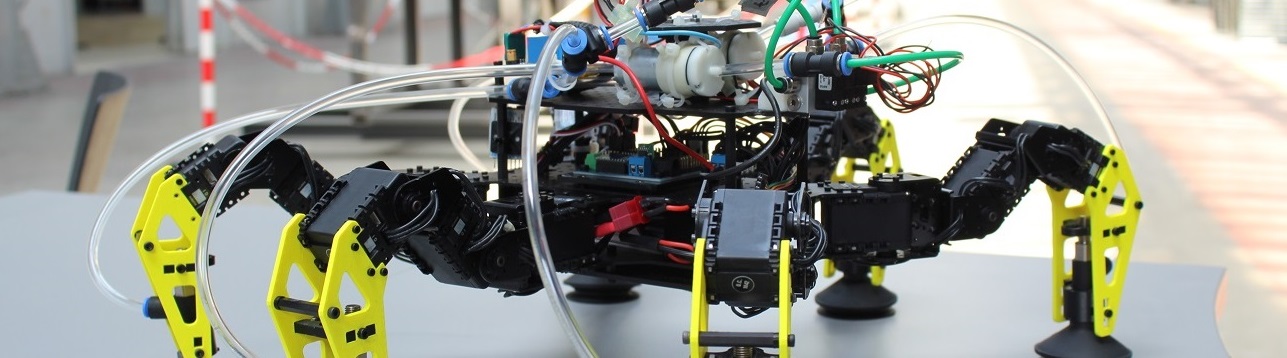
"We named it LEEAA, which stands for 'Light Expert Examination Automated Arthropod'. The idea came during testing of the robot after assembling the kit: the robot deviated slightly to the right or left in a rather unpredictable manner, hence 'Léa' in reference to the song by Louise Attaque, then the English acronym to match.
We modified the legs of our "spider" (it only has six legs, so it's not really a spider) to incorporate suction cups, activated by a centralized pneumatic system according to the walking sequence. The suction cups allow it to adhere to all types of materials, while preserving the integrity of the surfaces on which LEEAA moves.
After six very instructive months working on the project, Guillaume passed the baton to a second team of three students, who continued developing LEEAA.
What should we say to future candidates?
"Take advantage of these project times to let your imagination run wild and have fun! It's your project, and it's rewarding to see the effects of your work firsthand."
To apply, click here