
How does the aerospace industry use maintenance as a major economic and competitive factor? Insights from Nazih Mechbal, Marc Rébillat, Eric Monteiro, Mikhail Guskov, and Etienne Balmès, professors at the PIMM Laboratory. PIMMLaboratory, DYSCO Team (Dynamics, Structure, Control).
From planned maintenance to condition-based maintenance
The maintenance strategies currently implemented in the aviation industry are referred to as planned maintenance and consist of scheduling a certain number of interventions on aircraft. After a certain number of flight hours, visual inspections of critical components must be carried out. At less frequent intervals, these components must be completely dismantled for a full check of their structural integrity. This maintenance strategy, which is imposed by current aeronautical standards, is unsatisfactory because, in most cases, it requires the aircraft to be grounded when this is not necessary, and because it is based on human intervention, which can lead to errors of judgment. The current question being asked by the scientific community and the manufacturers that support it is therefore how to propose solutions that will enable a shift from a strategy of planned maintenance to a condition-based maintenance strategy. condition-based maintenance will only be carried out when necessary and following an automated diagnosis performed independently by the aeronautical structure concerned. The prerequisite for switching to conditional maintenance is to make the structures to be monitored intelligent by equipping them with sensors, actuators, and algorithms that enable them to automatically and independently diagnose their structural health.
A research topic leading to a variety of work
This multidisciplinary topic, which combines signal processing, structural dynamics, artificial intelligence, and instrumentation, has given rise to numerous research projects. At Arts et Métiers, these projects are led by, among others, the DYSCO (Dynamics Structures Control) team at the PIMM Laboratory. PIMM (Procédés et Ingénierie en Mécanique et Matériaux) and more specifically by Nazih Mechbal, Marc Rébillat, Eric Monteiro, Mikhail Guskov, and Etienne Balmès. Recent projects on this topic include the European H2020 MORPHO project (https://morpho-h2020.eu/) and the ANR COQTEL project (https://coqtel.cnrs.fr/), both coordinated by the DYSCO team at PIMM.
The piezoelectric element, which detects faults and ensures greater safety in aeronautical structures
The original approach proposed by this team of researchers consists of equipping aeronautical parts (mostly made of multilayer composite materials) with piezoelectric elements. The piezoelectric effect corresponds to a coupling between mechanical and electrical quantities: a piezoelectric element subjected to a force will generate an electrical voltage, and conversely, if the same element is subjected to a voltage, it will develop a certain force. Due to the reversibility of the piezoelectric effect, these elements will therefore have the dual role of sensors and actuators. The elements permanently installed on the structures will make them intelligent and will be used to probe them automatically and regularly via ultrasonic waves produced between 100~kHz and 200~kHz. As soon as damage appears in the host structure, an ultrasonic echo associated with this damage will be produced and dedicated monitoring algorithms will then be able, thanks to this unique signature, to detect the damage, locate it, classify it, and estimate its severity. These technological advances have been validated in the laboratory and also during flight tests carried out in Toulouse on Airbus A380 nacelles. In Figure 1, the two parts of the A380 nacelles equipped with piezoelectric elements (the fan cowling and the internal fixed structure) were photographed just before takeoff.
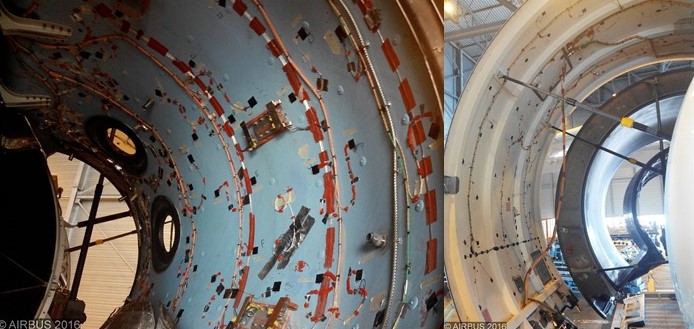
Figure 1: The two parts of the A380 nacelles equipped with piezoelectric elements (the fan cowling and the internal fixed structure) photographed just before takeoff.