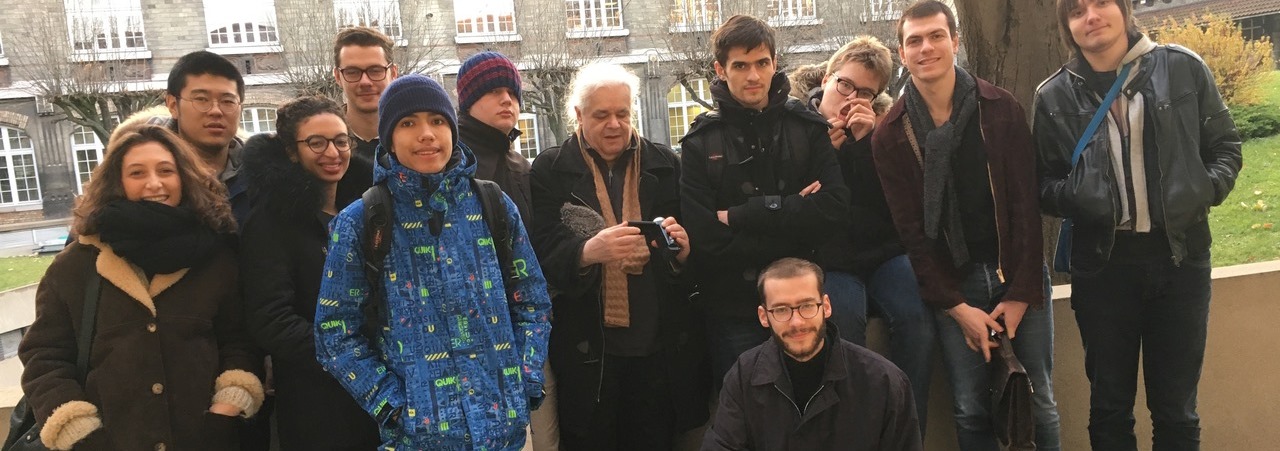
On Thursday, November 30, the Arts et Métiers campus Arts et Métiers Paris welcomed five young people with high-functioning autism with a twofold objective: to introduce them to various fields of technology while raising awareness of this disability among engineering students.
On Thursday, November 30, 2017, the first edition of theArts et Métiers WorkshopsArts et Métiers place on the Paris campus. Organized by two students from the school, Maurice Lubetzki and Martin Millischer, this event provided an opportunity to introduce young people with high-functioning autism to various fields of technology, while raising awareness of this disability among the school's engineering students.
In designing these workshops, we wanted to demonstrate that people with autism, who are too often marginalized in French society, have a place in industry. Disability should be a strength within a company, helping to accelerate its development and showcase its social values. That is why we believe in creating more humane teams, based on values of mutual support and cohesion.
Five young people with high-functioning autism were invited: Samuel (18) and Pierre Jean (15), who are in their final year and second year at Albert Demun High School; Alexis (19) at the Cachan University Institute of Technology; and James (23) and Pierre (19) in preparatory classes for engineering school, who share a common interest in science, technology, and industry. Each guest was accompanied by an Arts et Métiers student and a second companion if necessary.
Three introductory workshops on technology
The first workshop focused on 3D printing. Each student-guest pair worked on computers using computer-aided design (CAD). They were introduced to the different features of 3D printing and given a simplified explanation of how to obtain a CAD model of a desired part. The student organizers were impressed by how quickly the autistic participants understood and implemented the information conveyed during the workshop. The students were also able to print what they had modeled on CATIA and left with their first 3D-printed part.
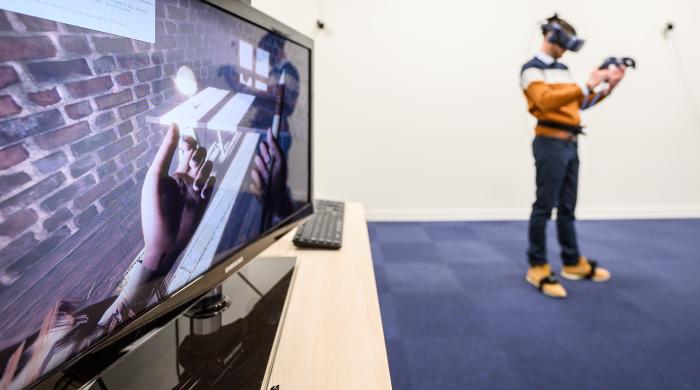
The second workshop focused on biomechanics. Everyone went to the testing room to learn how to model movement and exertion on a computer. Louis Clavel, a doctoral student Arts et Métiers, explained how the room worked. Then, each guest put on a suit and had fun watching their limbs move on a computer screen. This experience generated a lot of questions about careers and opportunities related to biomechanics. Intrigued and interested by this new discovery, each person with autism agreed to put on the suit covered with markers. This allowed them to fully understand how the room worked while playing an active role in the workshop.
Finally, the last workshop focused on fluid dynamics. The guests visited the DynFluid laboratory accompanied by Mr. Massou, who explained the various research projects currently underway. They then watched and discussed a short video on fluid flow around a car. The workshop concluded with a visit to the wind tunnel, which was not turned on to avoid excessive noise.
A human experience above all else
Maurice, Martin, Loubna, Thomas, and Kamil say they are "very happy" to have organized the first edition of the Arts et Métiers Workshops. Feedback from guests has been very positive, with many saying that it has reinforced their desire to pursue a career in science. In addition, Arts et Métiers students particularly Arts et Métiers interacting with people with autism and say they are very willing to work with people with this condition in the future. This first event can therefore be considered a success.
Our ambition: to spread the AteliersArts et Métiers all campuses and raise awareness among engineering students about people with autism.
The participating team
- Martin Millischer
- Loubna Baroudi
- Thomas Hu
- Kamil Blaszczuk
People with autism were contacted in collaboration with the Ile-de-France Autism Resource Center (CRAIF), various Special Education and Home Care Services (SESSAD), andthe Asperger Amitié association.