For more than twenty years, the Arts et Métiers campus Arts et Métiers Bordeaux-Talence has been a major player in research into engineered materials.
Within the DuMAS (Durability of Materials, Assemblies, and Structures) department of the I2M* laboratory, researchers and engineers are exploring how the internal geometry of materials, from the nano to the macroscopic scale, can combine lightness, mechanical performance, and durability. This scientific field is now strategic for many industrial sectors.
Understanding sustainability through engineered materials
This work was prompted by a simple, practical question: how can structures be made lighter while maintaining (or even improving) their mechanical performance, particularly in terms of resistance to impact and repeated stress?
Initial research focused on natural cellular materials (such as balsa wood or wood) and synthetic materials (polymer foams), which are valued for their excellent mass-to-performance ratio. These materials are capable of absorbing a great deal of energy without adding weight to structures.
The rise of additive manufacturing, particularly in metals, marked a turning point. It is now possible to precisely control the internal geometry of materials, raising a key question for the DuMAS department: how does metal additive manufacturing influence the mechanical properties and overall durability of a material?
To answer this question, researchers are adopting a multi-scale approach (micro, meso, macro), combining numerical modeling and experimental validation.
From bio-inspired to advanced manufacturing: the IEA BIM project (Bio-inspired, functionally graded nano-architectures for Impact Mitigation)
This approach is particularly evident in the IEA CNRS project, conducted in collaboration with MIT.
The objective: to design bio-inspired nano-architectured structures based on the study of natural cellular materials such as the skin of Citrus maxima (grapefruit).
The design of these architectures is based on tools developed at DuMAS, including Microgen, an open-source software program that can generate and configure periodic or random architectures, incorporating tortuosity and density variations.
These structures are then manufactured using additive manufacturing:
• at the micro and nano scale, using 2-photon lithography, through international collaborations;
• at larger scales, using the campus's FuturProd platform, which allows these concepts to be transposed to metal structures.
Testing, observing, modeling: from the laboratory to the crash
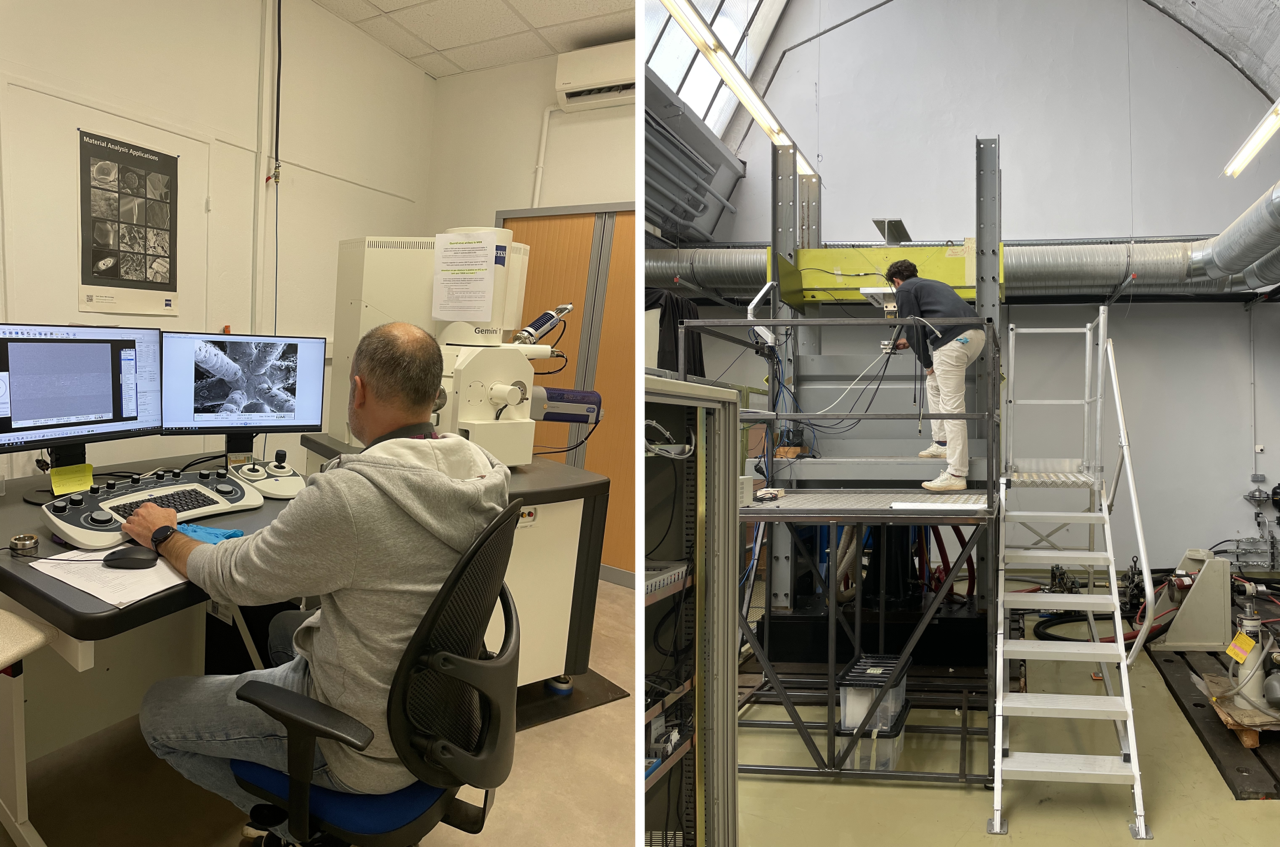
The evaluation of these materials begins at the microstructural level, using cutting-edge techniques such as electron microscopy, EBSD, and tomography. These tools enable a detailed correlation between the manufacturing process, internal architecture, and mechanical properties.
The mechanical tests then cover a wide spectrum: from quasi-static to very rapid dynamic stresses. As part of the IEA project, nano-architectured structures are tested at different deformation speeds using a nano-indenter, then subjected to very high-speed impacts.
Researchers also rely on large instruments, notably synchrotron nanotomography (ID16B – Grenoble), capable of observing architectural changes in 3D with a resolution of around several tens of nanometers. This data feeds into high-fidelity digital models, which are used to predict the lifespan of materials and optimize their architecture.
This constant back-and-forth between experimentation, advanced imaging, and digital simulation is the DNA of DuMAS.
An ecosystem focused on industry and societal impact
This research is part of a continuum of public funding (Region, ANR, Carnot, IEA CNRS) and industrial partnerships. Major players such as the CEA and Safran are directly interested in these materials, which can lighten structures, absorb energy, and maintain their performance under severe stress .
Twenty years after the first studies on polymer foams, the structured materials developed in Bordeaux-Talence—ranging from bio-inspired to metallic and from nanometers to meters—are now opening up major opportunities for aeronautics, energy, medicine, mobility, and construction, where the triptych of mass, performance, and environmental impact has become strategic.
*Bordeaux Institute of Mechanics and Engineering (I2M / Arts et Métiers, CNRS, University of Bordeaux, Bordeaux INP, INRAE)