Saptarshee MITRA is a doctoral student at the MSMP laboratory .
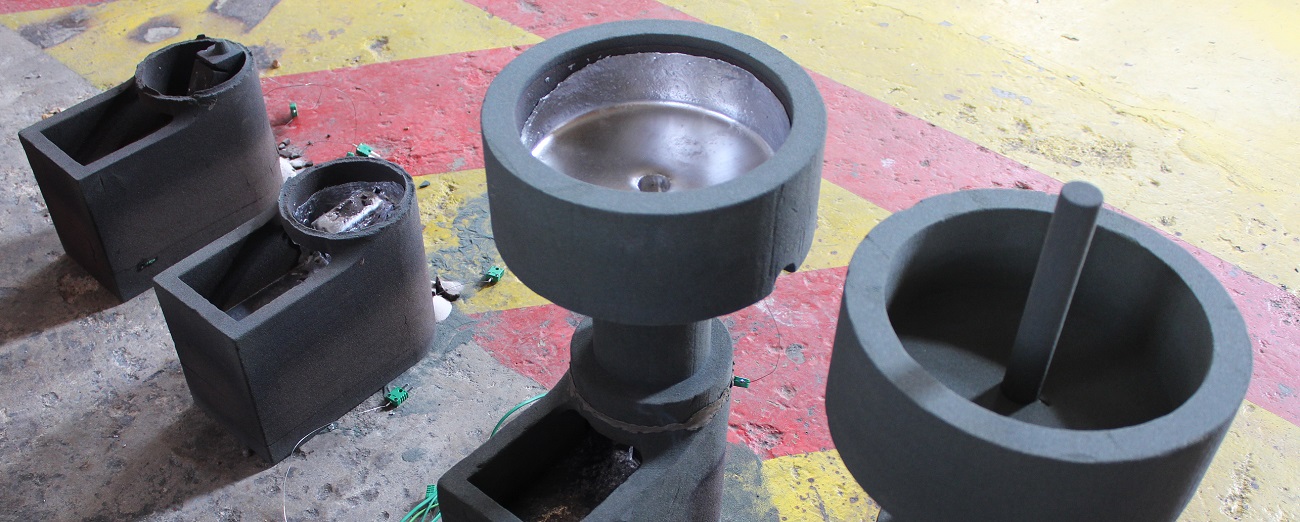
He has worked on the experimental and numerical characterization of the functional properties of sand molds produced by additive manufacturing (3D printing process using binder jetting) in rapid casting.
Summary
Traditional techniques for producing sand molds and cores used in foundries for metal casting are currently being replaced by additive manufacturing methods to help the aerospace/automotive industry manufacture complex-shaped parts in a practical manner.
The aim of this research is to study the functional properties of 3D-printed molds used in the casting of complex-shaped parts for engineering applications. First, the mechanical behavior of 3D-printed sand molds was analyzed and characterized for different printing process parameters. Next, the mechanical and mass transport properties of 3DP sand molds were studied. 3D-printed parts for foundries are often manufactured using a type of additive manufacturing technology called the powder-binder-jetting process. Measurements of flexural strength, density, porosity, and permeability were taken at three points on molds manufactured using additive technology.
In addition, the influence of temperature and binder volume fraction on mechanical and mass transport properties was also studied.
Furthermore, the permeability of printed sand molds was also characterized by X-ray microtomography, enabling advanced modeling of the porous microstructure in several steps:
1) computed tomography of small samples of 3DP molds,
2) 3D volumetric reconstruction of data,
3) numerical simulation for permeability prediction from reconstructed volumes,
4) modeling of the pore network to determine the distribution of pore sizes and constrictions.
Experiments were also designed to study 3D-printed molds in terms of erosion during metal casting. This made it possible to identify the optimal parameters for the 3D printing process for molds, not only in terms of their mechanical and mass transport properties, but also to minimize mold erosion during metal casting. A method for determining the erosion resistance of sand molds was also proposed, based on measuring the volume of the eroded surface using a modern reverse engineering technique.
Composition of the jury
Liam BLUNT, Professor, Center for Precision Technologies, University of Huddersfield, Rapporteur
Jean-Yves HASCOET, Professor at Ecole Centrale Nantes - GeM UMR CNRS 618, Rapporteur
Ismail LAZOGLU, Professor, Manufacturing and Automation Research Center, Koc University, Examiner
Michel BELLET, Professor at Mines ParisTech, Center for Material Forming (CEMEF) UMR, Examiner
Mohamed EL MANSORI, Professor MSMP-EA 7350, Arts et Métiers, Examiner
Antonio RODRIGUEZ DE CASTRO, Senior Lecturer MSMP-EA 7350, Arts et Métiers, Examiner
Marius COSTIN, Research Engineer, List Institute | CEA Saclay – DIGITEO Labs, Examiner