The European PERSEUS project aims to increase the efficiency of pulse jet actuators in order to reduce aircraft pollution. DynFluid is responsible for the numerical and theoretical work.
Check for detachments
PERSEUS (Pulsed jEt actuatoRs for SEparation control of tUrbulent flowS) is a CleanSky2 project, a joint technology initiative between the European Union and major players in the aerospace industry.
The aim of CleanSky is to develop a set of technologies necessary for a "clean, innovative, and competitive air system." The objective of the PERSEUS project is to increase the efficiency of pulsed jet actuators for controlling boundary layer separation.
During approach or landing, an aircraft's angle of attack is greater and the fluid layers attached to the aircraft's walls can become detached, leading to increased aerodynamic drag and therefore higher fuel consumption.
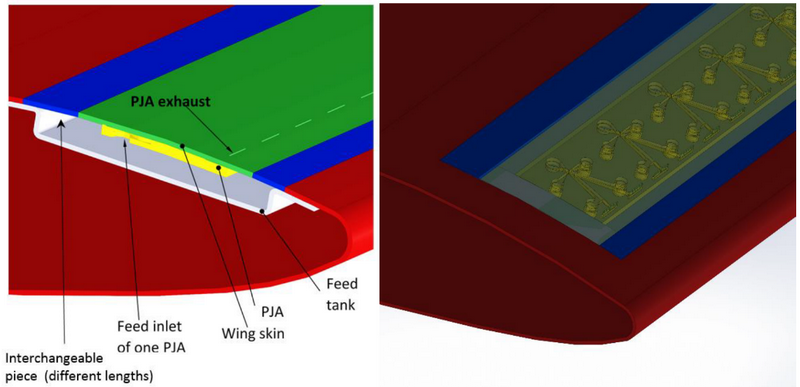
To counter this phenomenon, small pulsed jets emerging from orifices placed in specific positions can be used. Airbus Germany is conducting studies on this subject and aims to increase the efficiency of this type of device.
The French consortium comprising the PRISME laboratory at the University of Orleans (coordinator), the ICARE institute at INSA Toulouse, and the DynFluid laboratoryArts et Métiers been selected to lead this optimization effort: the PERSEUS project began on September 1, 2020, and will run for 30 months.
DynFluid in charge of numerical and theoretical work
The ICARE institute develops innovative fluidic actuators, which will be tested in the PRISME institute's wind tunnel.
The numerical and theoretical work carried out at the DynFluid laboratory provides support in two areas.
On the one hand, high-fidelity simulation of compressible flow inside the actuator will provide a better understanding of this complex flow in order to optimize it or validate less costly simulations. These are intensive simulations that will be carried out with the support of a postdoctoral researcher and will be based on a simulation code written at the DynFluid Laboratory.
In addition, a sensitivity study will be conducted to optimally position the pulsed jets and maximize their effectiveness. This action, coordinated by Jean-Christophe Robinet, university professor at DynFluid, will be carried out in collaboration with the University of Orleans (PRISME) and will be based on innovative theoretical developments fueled by large-scale numerical simulations.