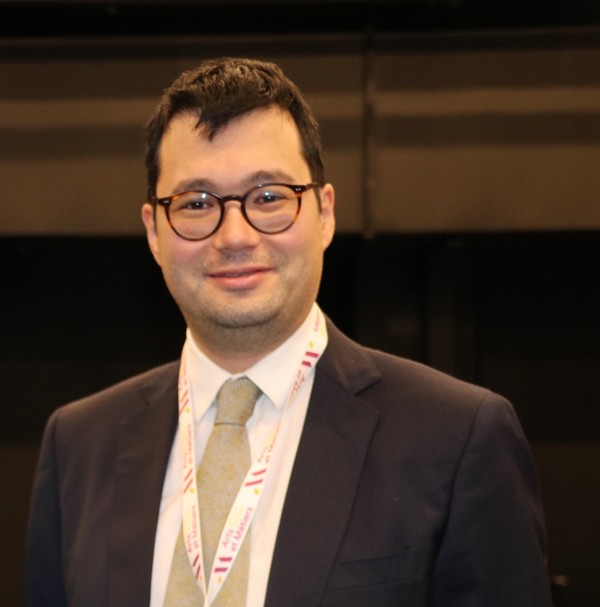
Jean-Rémy Chardonnet has just been appointed head of the Franco-German Institute for Industry of the Future, an organization created by Arts et Métiers KIT.
What is the objective of the Franco-German Institute for the Industry of the Future?
A dual degree program has existed between the Arts et Métiers campus Arts et Métiers Metz and KIT for 25 years. The institute was created in 2016 to develop interactions between Arts et Métiers researchers from all campuses and those from KIT.
Workshops are organized regularly around three themes: augmented reality/virtual reality, production systems, and advanced manufacturing. A fourth, more cross-disciplinary theme is also central to our work: artificial intelligence.
As part of this partnership, I spent a year at KIT in 2019, which greatly strengthened my ties with my German colleagues and made me want to further develop our collaborations.
What does this partnership bring to Arts et Métiers KIT?
KIT and Arts et Métiers two institutions with complementary strengths.
KIT has close ties with German industry, at the forefront of the industry of the future with global leaders such as Bosch, SAP, and Siemens.
Arts et Métiers to train engineers who are leaders in responsible industries, which brings an important component related to "social and environmental responsibility," and who are capable of innovations that are the strength of the institution in, for example, "manufacturing processes" or "life cycle digitization."
Developing our cooperation is therefore important because the two institutions have a lot to offer each other.
What types of projects do you want to develop?
The Franco-German institute already has a significant research program.
Today, beyond the dual degree that exists in Metz, we could develop courses in industrial engineering, robotics, or immersive technologies, for example. Offering joint continuing education programs is also an interesting avenue to explore.
Finally, we could draw inspiration from and adapt what is offered in entrepreneurship with TAMU, as start-up development is also one of KIT's strengths.
His work at the institute in Chalon-sur-Saône
He is involved in the ANR Team-Sport project, which aims to induce identity positioning among top-level players in a team.
He is also supervising several theses: one with Renault to evaluate cognitive biases between a physical vehicle prototype and its digital model, which is undergoing constant modifications; another with Cegelec to validate the simulation of complex movements in virtual reality.
As part of the Franco-German doctoral college, he is involved in two other theses, including one that has been defended, related to virtual reality/augmented reality and artificial intelligence.