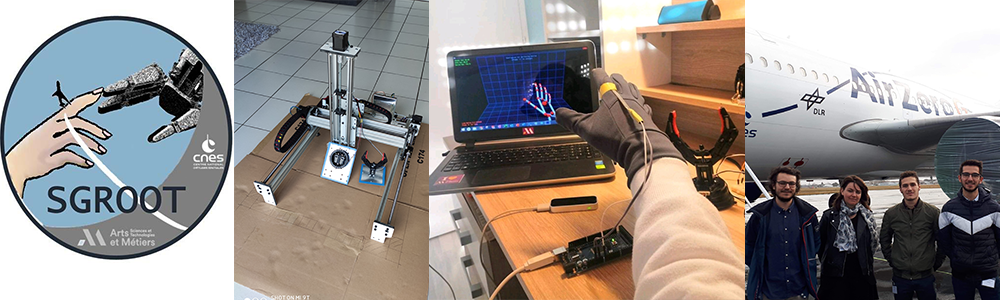
How can you control a robotic arm in a zero-gravity environment using your own body movements? This is the project being led by a team of four first-year students in the Grande Ecole Engineering Programme at the Arts et Métiers campus Arts et Métiers as part of the "Projet Parabole" competition organized by the CNES (National Center for Space Studies).
Every year, the CNES launches the "Parabole" competition, which offers selected teams the opportunity to conduct a weightless experiment aboard the Airbus A310-0G. Interview with Simon Leduc, a member of the SGROOT project team selected for this competition.
Why did you enter the "Parabole" competition organized by CNES?
I am passionate about aerospace, so I immediately found this competition very interesting. I surrounded myself with enthusiastic students who wanted to set up an innovative and practical project. So we submitted our application and were selected. We are one of only three teams nationwide to have been selected from among 32 projects throughout France. This is a real opportunity, as it will allow us to conduct a parabolic flight and test our project in zero gravity conditions. It's a real scientific experience, and we're working on the project from start to finish!
Can you tell us about your project that was selected?
In October 2019, we began working on a project called SGROOT (Sensitive Gripper Robot for Optimum Operator Tasks). This is a new-generation robotic arm control system consisting of a control glove equipped with an accelerometer, flexion sensors, and vibrating micro-motors to simulate haptic feedback in the fingers, and a robotic arm with a wrist and gripper that replicates the pilot's movements.
The scientific objective of the project is to study the operator's behavior under different gravitational accelerations in order to understand and compare the differences that may arise during different tests of this robot's piloting. Controlling a robotic arm simply by moving one's arm and hand, without the need for complex control panels, could facilitate the use of rovers (vehicles designed to explore the surface of another planet) on the Moon or Mars, directly from a nearby base or space station.
How does being in zero gravity affect the project's results?
This is the core of our project. We will be able to study human behavior and adaptation in a weightless environment.
We want to visualize how humans can adapt by understanding a loss of their bearings and experiencing their bodies differently.
Studying the differences between a normal environment and one in zero gravity and hypergravity (where you feel up to twice your own weight) is key to ensuring that astronauts will be able to use this technology in conditions that are very different from those we know on Earth. Beyond such applications, easily controlling a robotic arm in environments that are hostile to humans could have applications in areas such as nuclear power or rescue operations following natural disasters.
What skills do you need for this project?
This project is a great opportunity to apply the hard skills we learn at Arts et Métiers mechanical design, electronic circuit design, and microcontroller programming. Soft skills or cross-functional skills are not left out, as team and budget management, planning, and risk management are also key elements of such a project.
Our general education at school is applied in a project of this type, which is very interesting. It will definitely be useful in our future careers.
Can you tell us more about this flight that took place in early October?
We took part in a parabolic flight in the Airbus A310 ZERO-G, an aircraft operated by the company Novespace , which operates this type of flight. The aircraft performed a parabolic trajectory to enter free fall and thus create microgravity conditions.
There were two of us who were able to board and experience 20 seconds of weightlessness and the same amount of time in hypergravity (at almost 2G), with a total of 30 cycles. We were surrounded by researchers and professionals and had to undergo medical examinations to ensure that we were physically fit to fly in weightlessness. It was an unforgettable day!
The aircraft, which is the same size as those used for vacation travel, will perform a free fall of several kilometers, several times in a row. It is essential that risk management be carefully considered.