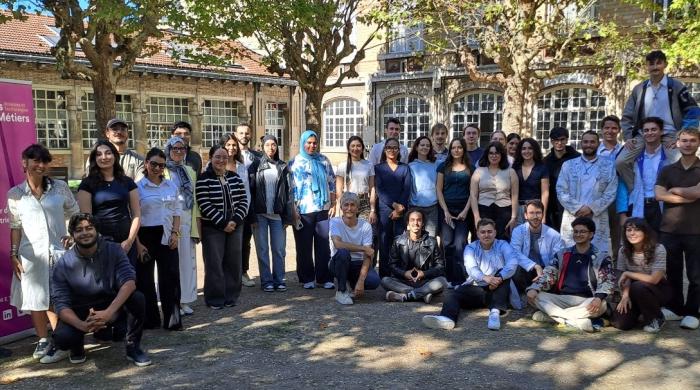

Arts et Métiers laboratories and research teamsArts et Métiers involved in numerous European projects as partners or coordinators. Most of these collaborations meet objectives shared by research and industry in order to adapt to current technological developments, particularly in terms of sustainable development.
Arts et Métiers participationArts et Métiers European Commission programs thus contributes to maintaining a high level of expertise in the conduct of its research activities.
Overview of European Arts et Métiers projects Arts et Métiers funded by the European Union's prestigious Horizon Europe program.

The MARS (Manufacturing Architecture for Resilience and Sustainability) project aims to stimulate technological innovation and help mitigate the numerous supply chain crises currently affecting European SMEs, a major pillar of the European Union's economy.
The use of AI-driven digital manufacturing processes should enable manufacturing SMEs to innovate and enter geographically distributed process chains.
More specifically, by bringing together the complementary expertise of several European partners, MARS will develop new Industry 4.0 technologies, such as digital twins of products, processes, and machines; bio-intelligent production devices with local intelligence and high detection coverage; central intelligence based on fleet learning approaches; manufacturing process models that take into account a variety of data, blockchain for data hashing, traceability, and data security, multi-agent-based production planning, and multi-criteria optimization of processes and resources, particularly for environmental footprint.
- Website: MARS (mars-horizon.eu)
- LinkedIn: https://www.linkedin.com/company/mars-euproject/

LF4VET (Learning factories for pedagogical and digital transformation of VET systems) is an ERASMUS+ cooperative project that aims to support vocational education and training (VET) centers in their digital, ecological, and pedagogical transformation through the promotion and development of Learning Factories (or "Factory Schools"). The aim of the project is to define ways of integrating Industry 5.0 technologies (AI, robotics, digitalization) into these centers through concrete pedagogical situations that place people at the heart of learning.
The project is led by the Basque center IESFP Miguel Altuna for a period of 30 months and brings together three other academic partners: Arts et Métiers, FH JOANNEUM, and Teaching Factory.
- Website: https://lf4vet.eu/
- LinkedIn: https://www.linkedin.com/company/lf4vet/

The GENEX project aims to develop a new digital structure driven by digital twins and using improved models. The digital models integrate interdisciplinary knowledge of aircraft components and manufacturing/repair processes. The objective is threefold: to optimize the manufacture of composite parts, enable continuous aircraft operation, and improve composite repair processes to ensure aircraft safety and airworthiness.
- Website: Home | GENEX (genex-project.eu)
- LinkedIn: https://www.linkedin.com/company/genex-eu-project/

R3GROUP: Resilient Rapid Reconfigurable Production Process Chains
The objective of this project is to develop resilience strategies for reconfiguration. Industrial demonstrators will be developed in several production sectors (automotive, metal products, rubber and plastics, clothing, household appliances) facing different reconfiguration challenges (upscaling or downscaling, introduction of new suppliers, integration of multiple product ranges, resilience to hazards). The project will involve end users working in different business models (B2B, B2C) and at different levels of the chain (OEM, Tier 1).
R3GROUP will develop human-centered solutions and focus on retraining to support the adoption of new technologies.
- Website: https://r3group-project.com/
- LinkedIn: https://www.linkedin.com/company/r3group-project/

The GreenDilT project seeks to improve and rethink the use of digital technologies in higher education. This project was launched in 2023 for two years with the aim of helping higher education stakeholders (teachers, students, support staff, etc.) to use digital technologies through awareness-raising and training initiatives. The project brings together five partner universities: Politecnico di Milano (Italy), TU Delft (Netherlands), the National Institute of Sciences and Industries for Life and the Environment (AgroParisTech, France), and Arts et Métiers et Technologies (France), which is coordinating the project.

The PIONEER project seeks to develop an open innovation platform and an interoperable digital pipeline to optimize design through simulation. To achieve this, PIONEER will use feedforward control strategies to make industrial systems more efficient. These strategies are applied in high-throughput, low-volume production models. They are based on the connection between modeling and characterization of digital twin materials, which are themselves based on simulation and data-driven models and are updated by production data from embedded IoT devices and product quality.
- Website: https://www.pioneer-project.eu/
- LinkedIn: https://www.linkedin.com/company/pioneer-project/

Maxima: Modular Axial Flux Motor for Automotive.
The MAXIMA project aims to develop and validate a comprehensive methodology for the design and production systems of an electric motor for the automotive market. This methodology will need to take into account often incompatible constraints such as efficiency, cost reduction, high power/torque performance, and high recyclability, particularly for critical raw materials. MAXIMA will focus on a specific topology to achieve this goal: an Axial Flux Synchronous Machine (AFSM).
- Website: https://maxima-he.eu/project/
- LinkedIn: https://www.linkedin.com/company/maxima-horizon-europe/

The objective of the BATTwin project is to develop a flexible and scalable platform that uses digital twins to improve the efficiency and performance of battery cell production lines. This platform aims to prevent the manufacture of defective products in European factories by reducing defect rates on production lines. The proposed solution has four components: a method for managing and acquiring data from multiple sensors; a model for understanding data (Digital Battery Passport); digital twins enabling the modeling of key stages in the manufacture of electrodes, cells, and their packaging; approaches based on hybrid digital twins combining analytical simulation and modeling, user-centered workflows, and user objectives. The project thus aims to develop a decision-making tool for the design and control of production lines.
PROSECCO
The PROSECCO project aims to develop a modular and integrated innovation management system for networked co-design projects involving products and services. SMEs, start-ups, and modular units within large companies constitute the target group of end users. Other stakeholders in the creative process constitute an intermediate group.

IN-DEEP is a European doctoral network composed of nine doctoral students and high-level scientists with complementary areas of expertise in applied mathematics, artificial intelligence, high-performance computing, and engineering. Its main objective is to provide high-level training to the nine doctoral students in the design, implementation, and use of explainable knowledge-based deep learning (DL) algorithms to quickly and accurately solve inverse problems governed by partial differential equations (PDEs).
Overview of Arts et Métiers projects Arts et Métiers funded by the European Union's prestigious Horizon 2020 program, including Research and Innovation Actions (RIA), Innovation Actions (IA), ERC Actions, and Marie Skłodowska-Curie Actions:
CURRENT PROJECTS:
MORPHO (Manufacturing, Overhaul, Repair for Prognosis Health Overreach) aims to place printed fiber optic sensors in each aircraft engine blade, equipping them with cognitive capabilities from the moment they are manufactured and developing a digital/hybrid twin model. This will improve the blade manufacturing process and operational availability without compromising safety, as well as lifecycle management (LCM). The European Commission has awarded the project a €5 million grant as part of this research and innovation initiative, with Arts et Métiers the lead coordinator.

ACONIT (Actuators for Surge Control in Gas Turbines): the objective is to design, manufacture, and test actuators for controlling flow rate, which will be integrated into aircraft engines to meet the needs of the aerospace industry. By focusing on extending the stable operating range of the axial compressor, it will be possible to reduce the pumping margin by delaying the onset of stall.
PERSEUS
PERSEUS (Pulsed Jet Actuators for Separation Control of Turbulent Flows) will combine wind tunnel testing with numerical modeling and sensitivity analysis to determine the optimal parameters for improving pulsed jet actuators on separated turbulent flows over a 2.5D airfoil equipped with a flap. The objective of this approach is to determine the minimum net mass flow required by the pulsed jet actuators to compensate for the momentum deficit in the boundary layer and thus reduce CO2 emissions, while improving the aircraft's maneuverability, safety, and sustainability.
INEDIT (open INnovation Ecosystems for Do It Together process) is creating a European DIT ecosystem of open innovation for the co-creation of sustainable furniture. Through its dual digital and physical platform, it aims to demonstrate the innovation potential of collective manufacturing within the circular economy by designing globally while producing locally, thereby reducing CO2 emissions, creating business and employment opportunities in the EU, and limiting ethical concerns.

THREAD (Joint Training on Numerical Modeling of Highly Flexible Structures for Industrial Applications) focuses on mechanical modeling, mathematical formulations, and numerical methods for the design of extremely flexible thin structures, as well as the complex response of these structures under real operating conditions.
FASTMAT
FastMat (Fast determination of fatigue properties of Materials beyond one billion cycles) is a project designed to develop a new method that significantly reduces the time required for fatigue characterization, as well as experimental and numerical tools for the rapid determination of fatigue behavior.
DOMMINIO (Digital method for improved manufacturing of next-generation multifunctional airframe parts) aims to develop an innovative data-driven methodology for designing, manufacturing, maintaining, and pre-certifying multifunctional and intelligent aircraft parts through a cost-effective, flexible, multi-step manufacturing system.
COMETAS
COMETAS (COncurrent METAmaterial-Structure design using functionally graded metamaterials) is a multidisciplinary and cross-sector project that seeks to develop an innovative multiscale methodology for designing metamaterial structures using the functionalities of functionally graded mechanical metamaterials. The project combines the design of metamaterials and structures through double inverse analyses and substitute continuum models obtained using data-driven techniques.

XS-Meta (Cross-Scale concurrent material-structure design using functionally graded 3D printed Metamaterials): the objective is to train a new generation of researchers in the material-structure design of high-tech systems, using functionally graded 3D printed metamaterials. Applied mathematicians, materials science and manufacturing engineers, continuum mechanics engineers, and design engineers are combining their theoretical, experimental, computational, and industrial knowledge to create a completely new approach to the design of components with high industrial and social value.

ISOLA aims to develop, integrate, test, deploy, dismantle, and finally validate a new fully automated security system. This system will use innovative technologies to detect, monitor, and report any fraudulent incidents in real time.