Master of Science KIMP CII - Knowledge Integration in Mechanical Production - Design, Industrialization, Innovation

Main image
KNOWLEDGE INTEGRATION IN MECHANICAL PRODUCTION - DESIGN, INDUSTRIALIZATION, INNOVATION
Headline

Master of Science MoS) Master of Science Knowledge Integration in Mechanical Production - Design, Industrialization, Innovation (KIMP - CII) 

Main body text

Campus

Arts et Métiers in Metz

Program structure

Learning outcomes are achieved through a well-balanced training program that combines theoretical and practical learning sequences, during which students are placed in both academic and real-life industrial settings, to develop multiple cross-disciplinary skills.

The KIMP_CII program is a one-year Master of Science program that spans two semesters (Figure 1):

  • Fall semester (S3): From October to January
    This semester is dedicated to lectures and courses. These ones are composed by 4 scientific core courses of 12h each, 4 specialization scientific modules 24h each (to choose among 5 proposed), 1 language module of 24h, 2 professional courses, for a total of 30 ECTS.
  • Spring semester (S4): From February to September
    . The second semester is devoted to the Master of Science , a 6-month research project worth 30 ECTS credits. The internship may be completed at a company or a laboratory in France or abroad.

Learning outcomes

Careers of graduates and access to further studies

Graduates of this Master of Science have access to a wide range of career opportunities:

  • Careers mainly in medium and large companies in industry as an engineer/researcher, in numerous sectors (manufacturing, product design, services, consultancy) and fields (aeronautics, automotive, IT, transportation, energy, construction, health, plastics, and metallurgy)
  • Positions: project and process manager, consultant, researcher, head of R&D department

PhD positions in France or abroad in academia or industry (CIFRE).

Partners

ST Microelectronics, Dassault System, GM, INRS, KYU Associés, PSA, SNCF, SNECMA, TDC Software,
Westinghouse, Airbus, EADS, etc.

Henri Tudor Center, EPFL, Tsinghua and Beihang Universities, Karlsruhe Institute of Technology, KTH Royal Institute of Technology, Polytechnique de Montreal, University of Metz, Ecole Nationale d’

ICI-IC Course: Innovation, Design, and Engineering – Innovation and Design

Main image
ICI-IC Course: Innovation, Design, and Engineering – Innovation and Design
Headline

National Master of Science Degree Master of Science DNM) in Innovation, Design, and Engineering, with a specialization in Innovation and Design (ICI - IC)

Main body text

He proposes:

  • To contribute to methodological reflection on innovative design and interaction design
  • To conduct methodological research to optimize the design process (application to industrial projects)
  • Raise awareness of multidisciplinary and collaborative work in the field of design (multidisciplinary teaching team and students working with engineers, designers, and ergonomists).

Campus

Arts et Métiers Campus Arts et Métiers Paris

Program

Learning outcomes are achieved through a balanced training program that combines theoretical and practical learning sequences, during which students are placed in real academic and industrial settings in order to develop multiple cross-disciplinary skills.

The ICI-IC program is a Master of Science program spanning two semesters 

  • First semester (S3): September to February
    This semester includes 5 science modules, 1 language module, and 1 long-term research project, for a total of 30 ECTS credits.
  • Second semester (S4): March through September
    The second semester is devoted to the Master of Science thesis, Master of Science 6 months and is worth 30 ECTS credits. The internship will take place at a research institution (laboratory or company) in France or abroad.

Assessment method

Each module can be assessed through practical assignments, projects, reports, oral presentations, exams, and the assessment rules are explained at the beginning of the program. Each module is graded on a scale of 0 to 20.

  • For language modules (MLi):
    The final grade for each professional/language module must be ≥ 10, and there is no compensation between modules.
  • For science modules (MSi):
    The final grade for each science module must be ≥ 10, and there is no compensation between modules.
  • For the long research project (LRP):
    The final grade for the LRP must be ≥ 10.
  • For the Master of Science MTI) thesis:
    The final grade for the Master of Science thesis Master of Science be ≥ 10.

Make-up exams are held during the second semester.

Career opportunities

Depending on their results and career aspirations, graduates can pursue their professional careers as:

  • PhD student in a field related to design engineering, in academia or industry (CIFRE), with the aim of becoming a recognized expert in the field of interactive design.
  • Engineer/researcher in R&D in large companies or start-ups, in many sectors (industry, construction, services, consulting, etc.) and fields (automotive, aerospace, healthcare, IoT, etc.) in the field of interactive design.

Industrial partners

PSA, Renault, RATP, DGA, SNCF, EDF, Chanel, ELM Leblanc, Snecma, Valéo, GDF, Alcatel, CEA, Dassault
Aviation, Faurecia, Facom, Eurogem, Lyonnaise des Eaux, Comelli, Hutchinson, Sanofi, Medicalex, H4D,
Karis, Cegetel, AFM, etc.

Academic partners

Mines ParisTech, Strate Collège Designers, Telecom ParisTech, University of Technology of Compiègne,
University of Lyon 2, University of Angers, ENSAAMA, EGIM

TEEF COURSE - EMERGING TECHNOLOGIES FOR EDUCATION AND TRAINING (M1+M2)

Main image
TEEF COURSE - EMERGING TECHNOLOGIES FOR EDUCATION AND TRAINING (M1+M2)
Headline

National Master of Science Degree Master of Science DNM) in Emerging Technologies for Education and Training (TEEF)

Main body text

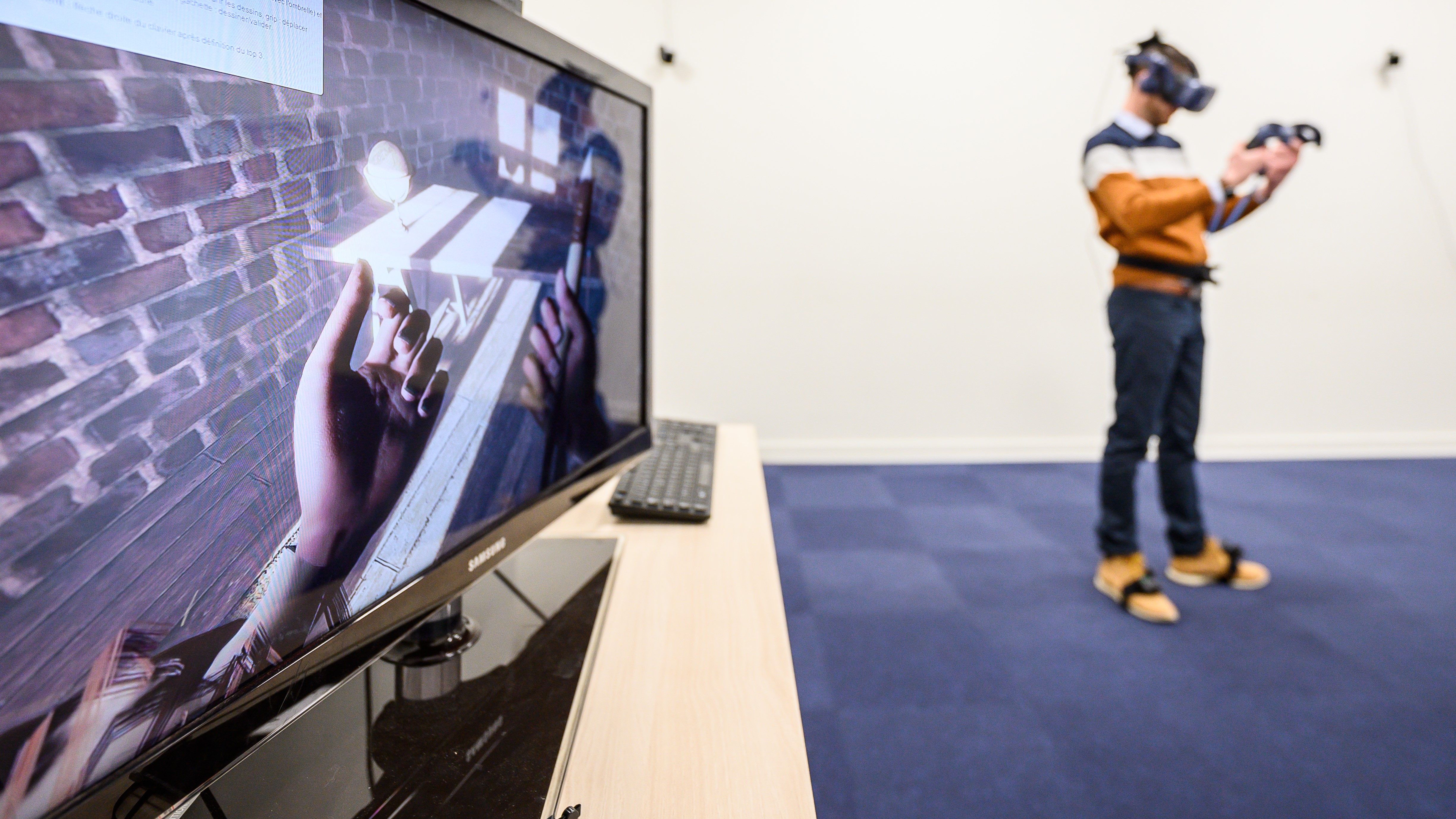
The Master of Science in Emerging Master of Science for Education and Training aims to train “educational technology engineers ” capable of designing, developing, and implementing training and learning systems that utilize emerging technologies such as XR (Extended Reality, which encompasses Virtual and Augmented Reality and Digital Twins) or AI (Artificial Intelligence) for teaching.

This Master of Science program is offered by Arts et Métiers partnership with Le Mans University. It is available exclusively as a work-study program lasting one or two years, designed to directly address the needs of the education and business sectors.

Campus

Laval Institute Arts et Métiers

Program

Master of Science Program Master of Science

The courses offered in M1 focus on engineering and educational accessibility, course design and facilitation, introduction to research, emerging technologies for training (XR, AI), learning analytics, trainer support, English, and project management. The M1 projects are heavily focused on pedagogy, coupled with teaching on cutting-edge technologies, to quickly develop the skills of students from computer science backgrounds in innovative teaching methods.

Master of Science Program Master of Science

The M2 aims to strengthen students' expertise with new projects and courses on the cognitive psychology of learning, the creation of multimedia resources, training evaluation, the design of an e-learning module, resistance to change in individuals/organizations, ethics, and training law.

Calendar

Early September to early April for theoretical training on a work-study basis + 5- to 6-month full-time period in a company (final defense in September)

Skills acquired

Graduates of Master of Science acquired both a broad understanding of the field of computer science and an in-depth knowledge of emerging technologies (AI, XR, etc.) and innovative educational tools (tools for designing immersive courses, etc.). In addition, they will have a strong pedagogical foundation that will enable them to make informed decisions. They may find employment at public or private higher education institutions, in companies that develop educational technology (edtech), in the training departments of large corporations, or in organizations specializing in vocational training.

Career opportunities

With a focus on emerging technologies, the Master of Science program offers graduates a wide range of career opportunities:

  • Educational engineer,
  • Designer of XR AI training tools,
  • Emerging Technologies and/or Training Project Manager,
  • Digital & Innovation Director,
  • Trainer, training engineer,
  • Researcher and lecturer-researcher in the fields of educational technologies

Admissions

Applications for Master of Science are submitted via the national platform www.monmaster.gouv.fr.
After their application materials have been reviewed, selected candidates will participate in a remote interview to assess their motivation, educational background, and the alignment of their career goals with the Master of Science requirements. Final admission to the Master of Science program Master of Science only possible once the applicant has signed a work-study contract (with a company, training organization, research laboratory, etc.).

Prerequisites

The M1 is accessible after a bachelor's degree (such as a bachelor's degree in computer science or a BUT in computer science and MMI), while the M2 can be taken after an M1, another M2 program, an engineering degree, or in the final year of engineering school.

Partners

This Master of Science program is offered by Arts et Métiers partnership with Le Mans University. It draws on the internationally recognized expertise of two research teams: the IEIAH team at LIUM (the University of Le Mans’ Computer Science Laboratory), which specializes in designing digital tools for education, and the Presence & Innovation team at LAMPA (Arts et Métiers), which studies learning with immersive technologies.

The training program benefits from the equipment of the CAPLAB platform operated by Clarté and Arts et Métiers Laval Virtual Center.

Training cost

Work-study training in the form of an apprenticeship contract or a professional training contract paid for by the company and its OPCO.

Contacts

Sylvain Fleury - Coordinator of Master of Science : sylvain.fleury@ensam.eu 

SDMR Program - Decision Sciences and Risk Management

Main image
SDMR Program - Decision Sciences and Risk Management
Headline

The Master of Science Decision Master of Science and Risk Management program was established in 1990 at the École Normale Supérieure (ENS) in Cachan and has been offered by Arts et Métiers since 2004. It provides research-based training in the challenges of risk management and decision-making under uncertainty. Naturally multidisciplinary, just as the concept of risk is, it prepares its graduates to pursue doctoral studies in a wide range of fields.

Main body text

Campus

Arts et Métiers Campus Arts et Métiers Paris

Program

The first semester includes the following theoretical courses:

  • Block 1 - Research methodology: Epistemology; Qualitative methods; Quantitative methods
  • Block 2 - Decision Sciences: Decision Analysis; Advanced Decision Theory; Microeconomics and Strategic Interactions
  • Block 3 - Risk Management: Management and Industrial Engineering (course from the Arts et Métiers Grande École Program); Risk and Organizations; Risks and Management Systems; Psychosocial Risks; Introduction to Finance
  • Block 4 - English for Research
  • Block 5 - Minor: Advanced Financial Theory; Methods of Technological Risk Analysis Seminars: Research Seminars

The second semester is devoted to writing a research paper, often carried out in conjunction with a company as part of an internship.

CAREER OPPORTUNITIES

  • Industrial sectors: consulting, financial services, auditing, energy, construction, transportation, manufacturing
    , etc.
  • Professions: Doctorate in management sciences, economics, finance. Careers in higher education, or in R&D, consulting, project management, risk management, health and safety.

PREREQUISITES

Master's degree in engineering, economics, or management

PARTNERSHIP

Academic partner: IAE Paris

KEY FEATURES

  • Diploma awarded in partnership between an engineering school and a management school
  • Multidisciplinary approach
  • Fast-growing field

CONTACT

Marc Lassagne: Head of Education
marc.lassagne@ensam.eu - Tel. + 33 (0)1 44 24 62 72
Campus Arts et Métiers Paris I 151, boulevard de l’Hôpital - 75013 Paris

Meeting with Mike Keesling, teacher at the Arts et Métiers training center Arts et Métiers Bergerac

Mike Keesling

With over 25 years of experience in the film industry, where he designed innovative technical equipment, including the famous Image Shaker, which won an Academy Award at the Oscars, Mike Keesling now shares his expertise with students enrolled in the Bachelor's degree program in Science and Technology, Industry Streams at Bergerac, guiding them through concrete and realistic projects that closely resemble industrial practices.