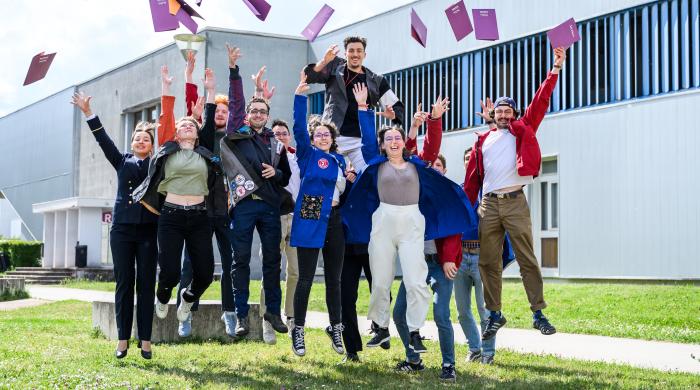
Arts et Métiers students with a bachelor’s degree the option of pursuing a two-year Master of Science program designed to consolidate and deepen their knowledge of science and engineering through a practical approach that involves hands-on scientific work in the Arts et Métiers :
- AM²S: Advanced Manufacturing and Materials Science (M1+M2)
- BioMedical Engineering
- Factory of the Future
- MTI3D Research Master of Science
AM²S: Advanced Manufacturing and Materials Science (M1+M2)
The Master of Sciencespecialization “Advanced Manufacturing and Materials Science” (AM²S) is situated at the intersection of France, Europe, the Mediterranean Basin, and the U.S. industrial ecosystem, offering AM²S courses in English for the Master of Science (MSc) and PGE 3rd ENSAM / Master of Science (MEng) degrees.
The objectives are also to increase students' knowledge in the field of manufacturing processes and materials science through multi-physics and multi-scale approaches, including smart and digital concepts. In other words, this program will focus on innovative scientific fields, from the physics and chemistry of materials to the use of manufactured parts, by developing the duality between experimentation and numerical simulation.
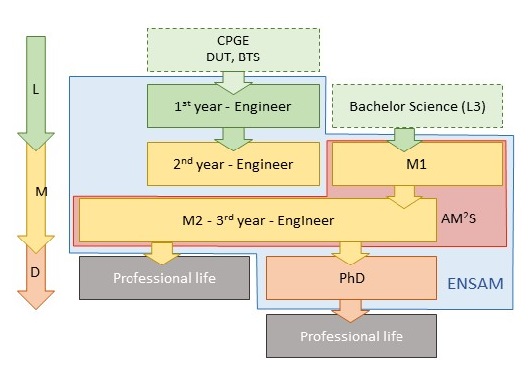
Arts et Métiers a two-year Master of Science in Advanced Manufacturing and Materials Science Master of Science graduates with a Bachelor of Science or Bachelor of Engineering degree.
Master of Science
The Master of Science Specialization in “Advanced Manufacturing and Materials Science” for Transport and Energy (AM2S-M1) serves as a direct pathway to a Master of Science program (e.g., AM2S-M2). The objectives are to prepare engineers for industrial and laboratory research and to deepen their understanding of the physics of manufacturing processes and the fundamentals of materials behavior, with the goal of designing processes to achieve specific physical properties. The courses are taught on the Aix-en-Provence campus in collaboration with the MSMP lab and the Learning Factories.
The courses consist of:
- One semester of core courses for 310 hours and 30 ECTS based on mandatory teaching units (TUs) during the first semester. These units will allow students to gain insights into mechanics and materials science for manufacturing processes and to understand the relationship between materials and processes. A TU will introduce the key skills for writing proposals and scientific publications.
- A second semester of courses with the research project in Manufacturing and Material Science (300 hours and 30 ECTS). Advanced materials and manufacturing processes will be addressed in order to optimize the processes to a targeted surface integrity (topography, residual fields, microstructure).
- Individual research internship lasting 6 to 8 weeks. The internship will be conducted in a research setting (university laboratory, industry research department). Dates: May-June – 6 ECTS.
Link to M1-AM²S Advanced Manufacturing and Materials Science
Master of Science )
The scientific objectives of the AM²S-M2 program emphasize a high-level scientific approach by:
- Improving knowledge of the relationships between materials science and manufacturing processes,
- Using multiphysics and multiscale approaches to better understand the relationships between materials/mechanics/processes,
- Mastering the numerical tools for optimizing the design of structures and parts with high added value,
- Using new technologies, in particular smart digitalization, big data, and numerical simulations.
These objectives will enable students to move on to a PhD program with knowledge and skills in materials science and/or smart manufacturing.
The courses are composed of:
- Core courses (150 hours, 15 ECTS) with 5 mandatory teaching units (TUs) during the first semester.
- Two Elective paths (150 hrs., 15 ECTS) with 3 mandatory TUs and 2 elective TUs during the first semester:
- Elective in Materials Science
- Advanced Manufacturing elective
- Individual research project (30 ECTS) for 6 months during the second semester. The internship will be done in a research structure (university laboratory, research department in a company in the field).
Link to M2-AM²S Advanced Manufacturing and Materials Science
Dual Degree Option withTexas A&M
A dual degree with TAMU for the M1+M2 track, where a full academic year atTAMUduring the second year is proposed upon academic selection after the first year.
The dual degree is offered in conjunction with the Master of Science Interdisciplinary Engineering (ITDE) atTAMU.
The course credits of M1-AM2S are transferred to the Degree of TAMU. 18 Semester Credits Hours must be completed at TAMU, including a research project. The research project also counts towards the M2-AM²S.
ADMISSION
- Foreign and French students can apply to the program.
- Graduates with a Bachelor of Science or Engineering degree only
- English proficiency: the minimum requirement is a TOEFL iBT score of 81/120 (or equivalent) or an IELTS score of 6.0.
- The selection is based on academic excellence, motivation of the candidate, and consistency of the professional project.
TUITION FEES
First year (M1)
- Tuition fees: 250 EUR / year (students from the European Union and outside the European Union)
Second year (M2)
- Tuition fees: 240 EUR / year (students from the European Union and outside the European Union)
Dual Degree option with TAMU (Master's 1 + Master's 2)
- Tuition fees for M1: 250 EUR/year (students from the European Union and outside the European Union)
- Tuition fees for the Dual Degree at TAMU (year 2): one full year with 18 Semester Credit Hours must be completed at TAMU, including a research project.
Download the AM²S M1 M2 brochure
BioMedical Engineering
Master of Science's degree in Biomedical Engineering lies at the intersection of two highly innovative fields: engineering sciences and biomedicine. This program is a partnership with University of Paris Cité —on which the Arts et Métiers relies—for engineering and technology.
Transdisciplinarity and the international dimension are the two pillars of the Master of Science program in Biomedical Engineering, which is designed for students from diverse backgrounds: not only biology, chemistry, and health sciences, but also engineering, computer science, mathematics, and physics. The primary goal is to provide students with skills in the key fields of biomedical engineering, which are becoming increasingly important in both research and industrial development.
Five specialties are currently available to candidates:
- Bioimaging (BIM)
- BioMaterials (BioMAT)
- BioMechanics: from tissues to musculoskeletal structures (BioMECH)
- Molecular and cellular biotherapies (MCB)
- Bioengineering and Innovation in Neurosciences (BIN).
Factory of the Future
Arts et Métiers a two-year Master of Science in "Factory of the Future" Master of Science graduates with a Bachelor of Science or Bachelor of Engineering degree: the first year focuses on fundamental sciences and industrial applications;the second year is devoted to specialization.
Students have the opportunity to become familiar with the different stages of a scientific research project, thanks to scientific immersion within Arts et Métiersresearch units. They develop project management skills while receiving in-depth education in engineering sciences.
When applying, students choose a specialization from among nearly 20 possibilities classified into three main areas (calculation, communication, and project management):
- Industrial Engineering
- Energy
- Ingénierie mécanique
The first year ( 60 ECTS) is taught on the Paris campus. Taught entirely in English, it involves two blocks: calculation (mathematics, data processing, numerical methods), communication and organization (bibliography techniques, project management, scientific communication in English, career development), and foreign language (French or English).
Students also attend required courses depending on the orientation of the specialization. An internship in industry (minimum 13 weeks) is also compulsory, to help develop professional skills.
A semester devoted to Master of Science
During the second year ( 60 ECTS), specific theoretical courses are offered in the first semester. Students then work on their Master of Science during the second semester. Coursework and Master of Science depend on the specialization chosen from among the 20 options inthree areas:
- Industrial Engineering
- Energy
- Ingénierie mécanique
See our list of specializations
Admission
- Both foreign and French students are eligible to apply for the program.
- Exchange students may take this Master of Science only during the first semester or for the entire academic year
- Graduates with a Bachelor of Science or Engineering degree only
- English proficiency: the minimum requirement is a TOEFL iBT score of 81/120 (or equivalent) or an IELTS score of 6.0.
- The selection is based on academic excellence, motivation of the candidate, and consistency of the professional project.
Tuition fees
First year (M1)
250 EUR/year (students from the European Union and outside the European Union)
Second year (M2)
250 EUR/year (students from the European Union and outside the European Union)
MTI3D Research Master of Science
The The MTI 3D Master of Science program aims to train experts in 3D interactive technologies. Through a combination of laboratory research and practical application, students are trained to create new products and services based on virtual technology—including virtual reality, augmented reality, 3D, and connected objects.
Two M2 (second-year Master of Science) courses are available : human-machine interactions (at the Arts et Métiers in Chalon-sur-Saône), innovation, perception, and management, engineering, and advanced virtual reality (in Laval).
This offers many career opportunities: R&D Manager, teacher-researcher, virtual reality or augmented reality engineer, IT project manager, consultant, or start-up entrepreneur.
Admission
The M1 (first-year Master of Science program) is open to applicants with a bachelor’s degree, while the M2 program is open to those who have completed the M1, another M2 program, an engineering degree, or a final year at an engineering school. After their applications have been reviewed, selected candidates attend an admissions interview and take an English proficiency test.