General engineer, student curriculum, third-year expertise in Mechatronics.
Campus
Arts et Métiers Campus Arts et Métiers Paris
Background
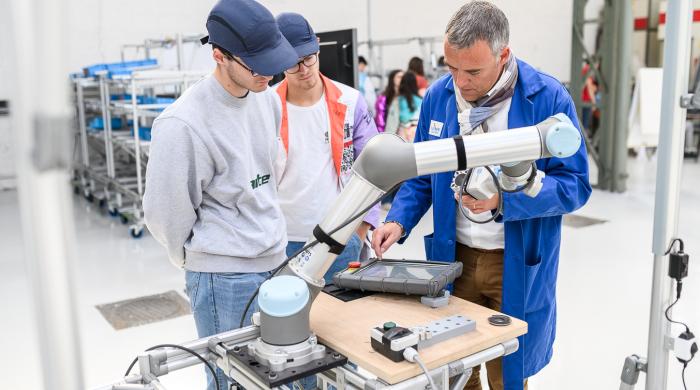
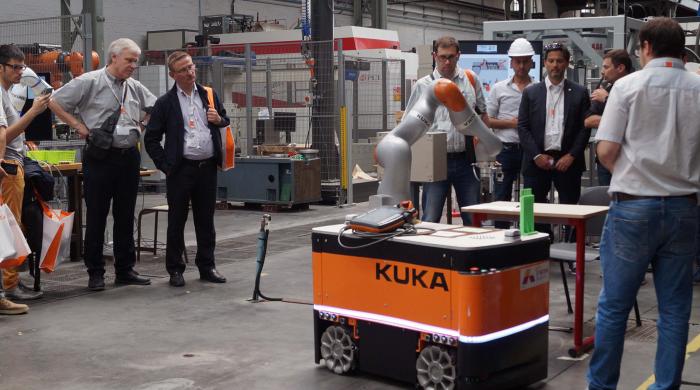
With the rise of smart, connected structures and systems, today's mechanical products increasingly incorporate electronics, computing, sensors, and actuators. This adds numerous features such as on-board diagnostics, the ability to react to their environment, and increased interaction with humans. For several years now, the term " mechatronics " has been used to refer to such systems, the design of which, by definition, requires multidisciplinary knowledge.
Objectives
The "Mechatronics" expertise unit trains engineers capable of (a) comprehending the design and implementation of complex systems (intelligent, connected, etc.) in their entirety, (b) identifying and mastering the constraints of integrating these systems combining mechanics, electronics, automation, and IT, (c) identifying and mastering the constraints of integrating these systems combining mechanics, electronics, automation, and IT, (d) identifying and mastering the constraints of integrating these systems combining mechanics, electronics, automation, and IT, (e) identifying and mastering the constraints of integrating these systems combining mechanics, electronics, automation, and IT, (f) identifying and mastering the constraints of integrating these systems combining mechanics, electronics, automation, and IT, (g) identifying and mastering the constraints of integrating these systems combining mechanics, electronics, automation etc.), (b) identify and master the constraints of integrating these systems combining mechanics, electronics, automation, and IT, and (c) design and develop methods for testing and validating the whole system.
Program
- Module 1: Mechanics, Mr. Guskov
Multi-body mechanical systems such as industrial machines or robots often perform complex movements. This module focuses on describing the trajectories of these systems (kinematic parameterization) and the relationship between their movements and the actions that determine them (forward and inverse dynamics). Students will learn how to input data for kinematic or dynamic simulation of the behavior of a complex mechanical system and interpret the results, with a view to designing the control system for such a system or dimensioning its actuators and sensors, for example.
Module 2: Automatic, Mr. Guillard
This advanced control course deals with robust control of multivariable systems. Its objectives are to present an overview of control techniques for dynamic multivariable, linear, complex systems and to study the practical and theoretical difficulties posed by a number of solutions based on knowledge of a mathematical model (state system) representing the system. After presenting the formalism used to analyze the robustness of a closed-loop multivariable system (unstructured uncertainties, singular values), various robust control laws that are particularly well suited to practical applications are studied: LQ/LTR control, H-infinity control.
- Module 3: Data Estimation and Fusion for Mechatronics, Mr. Mechbal
Over time, estimating the position, attitude, orientation, or structural state of a complex body/system/structure has become an important scientific and industrial challenge (for example, in aerospace, robotics, motion capture, or even monitoring and detecting defects/damage). In conjunction with dynamic models, sensors & actuators, and control laws, this course aims to provide toolsforestimating andidentifying the characteristics of complex systems or processes based on linear and nonlinear Bayesian approaches (Kalman filter, particle filtering, etc.) for the control, localization, and diagnosis of mechatronic systems. These tools are essential for recalibrating a mathematical model based on measurements, estimating the unmeasured component of a state vector, or "localizing" a mobile system using data fusion.
- Module 4: Computer Science for Intelligent Systems, Mr. Boulaire
Computer science is at the heart of the "intelligent" part of complex mechatronic systems. It is therefore necessary to master these tools in order to be able to implement a control law, an estimation process, or an artificial intelligence algorithm in real time. The objective of this course is to provide an introduction to programming in C++, Python, and ROS (Robotics Operating System). These tools will be applied in different contexts and case studies will complement the course.
- Module 5: Sensors and Actuators, Mr. Rebillat
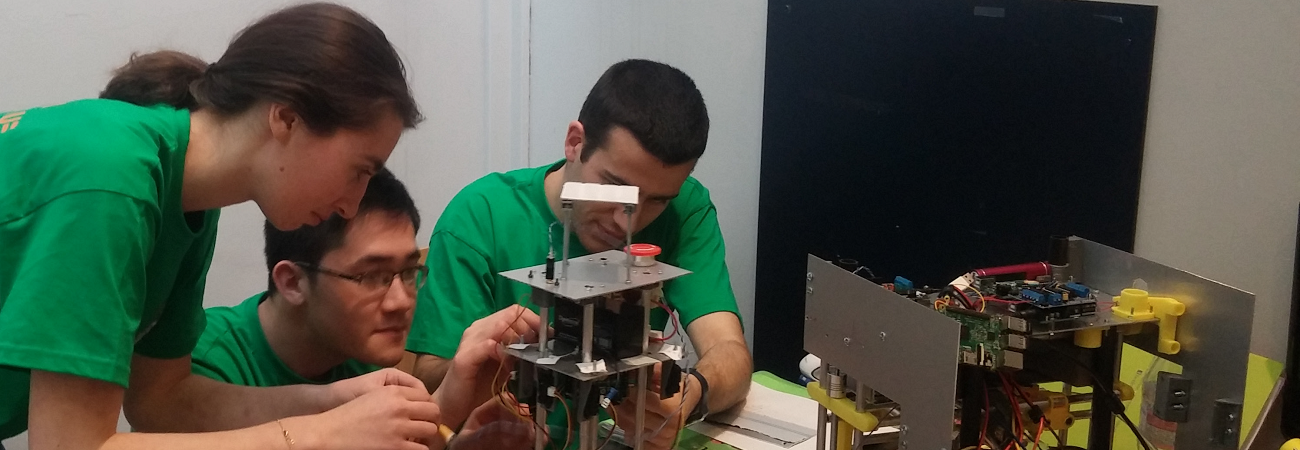
With smart objects omnipresent in our daily lives and in the industrial world, this course aims to provide future A&M engineers with the knowledge they need to design and select actuators and sensors for the applications they will encounter in their careers. Concrete and varied examples are covered in practical sessions and projects using Arduino and Raspberry Pi platforms.
- Module 6: Human-machine interface – HMI, Mr. Garbaya
- Module 7: Case studies / Lectures / Seminars
- In-depth project
Application and consolidation of knowledge acquired through participation in a group competition or challenge (4-6 students) on a given topic.
Examples of projects and internships
Assessment methods
- Grade per module: midterm tests, personal assignments, lab grades, and final exam.
- Final grade: weighted average of each module.
Key scientific and educational leaders
- N. Mechbal - Manager - +33 (0)1 44 24 64 58
- Mr. Rebillat
- Mr. Guskov
- R. Boulaire
- S. Garbaya
- H. Guillard (CNAM)
Practical information
- Level: Graduate
- Course Language: French
- Period: February - June
- Number of hours: 150 hours
- ECTS credits: 13
Keywords
#Mechatronics #MechanicalModeling #Control #Identification #FaultDetectionEstimation #AnalogAndDigitalElectronics #Sensors #IntegratedDesign