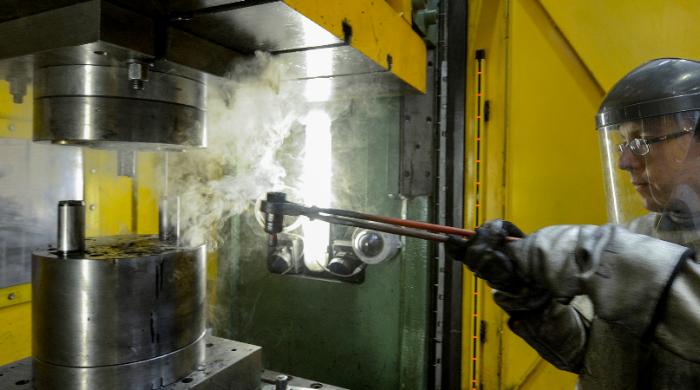
Arts et Métiers ESFF (École supérieure de Fonderie et de Forge) strengthened their partnership in June 2016 by signing a new agreement. This is an opportunity to raise awareness of the forging and foundry sectors, a modern industry that uses innovative technologies and whose graduates do not experience unemployment! Presentation with Pierre-Yves Brazier, director of the ESFF.
What role do forging and foundries play in French industry?
Forging and casting are now present in most sectors of activity, as an unlimited number of industries use forged or cast parts, including strategic or high-tech sectors such as aerospace, automotive, medical, energy production, electronics, aeronautics, rail, etc.
These two sectors employ more than 39,000 people and include nearly 460 innovative companies. Their turnover amounts to €7 billion, of which about one-third is generated by exports. Annual production amounts to 2,200,000 tons of high-tech parts. France is internationally recognized for its cutting-edge expertise in this field. It ranks third in Europe, behind Germany and Italy, and 11th worldwide, behind China.
How are these sectors evolving?
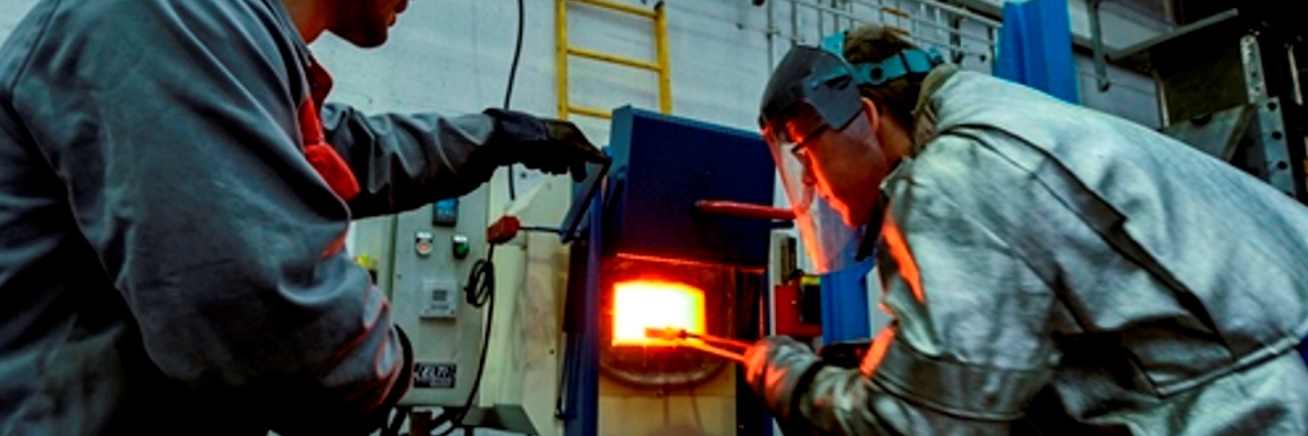
Forging and foundry work have become modern industries that combine innovation, expertise, and high technology. Significant efforts in R&D and the use of innovative technologies enable French companies to adapt to customer and market requirements in terms of quality, productivity, and environmental protection.
What innovative technologies are used?
Examples include the development of digital tools for topological design, calculation, and simulation of cooling and solidification behavior, as well as thixoforging, net shape forging, cross-rolling, metal additive manufacturing techniques, structured materials, and more. Before being integrated by manufacturers, innovations are created, studied, developed, and tested. This is a lengthy process that requires significant resources.
What are the job prospects for recent graduates?
With specific training, they quickly find employment. In fact, demand from companies exceeds the number of students graduating each year from institutions offering this type of training.
As a result, the number of apprenticeship contracts available for ESFF apprentices regularly exceeds the number of successful candidates in the competitive entrance exam, giving them a wide range of opportunities both nationally and internationally. This proves that the cutting-edge skills required for careers in metal forming offer young graduates high employability.
What does the partnership with Arts et Métiers bring you?
It should be noted that the two schools initiated a partnership in 2009 and formalized it in 2011 for forging courses in the form of lectures, tutorials, and practical work. These courses, intended for ESFF students, are held in the plastic deformation and permanent assembly workshop on the Metz campus.
The agreement signed in June 2016 opens up new bridges between the institutions and allows for the sharing of resources. It enables the awarding of a joint degree: "Engineer from the École Supérieure de Fonderie et de Forge in agreement with the École Nationale SupérieureArts et Métiers in partnership with the Institut d'Études Supérieures de Fonderie et de Forge."
The scope of the partnership has therefore been expanded, with Arts et Métiers gaining access Arts et Métiers the ESFF to the networkof partner companies on which the school relies in many industrial fields such as automotive, aeronautics, mechanics, and construction. For the ESFF, this new association contributes to broader communication about our professions. In addition, it opens up opportunities for both technological and scientific teaching (applied mathematics, industrial electricity, etc.) by drawing on the specific strengths of each campus (forging, foundry, mechanics, etc.) and on the provision of teaching resources and technical equipment that complement those of the ESFF.