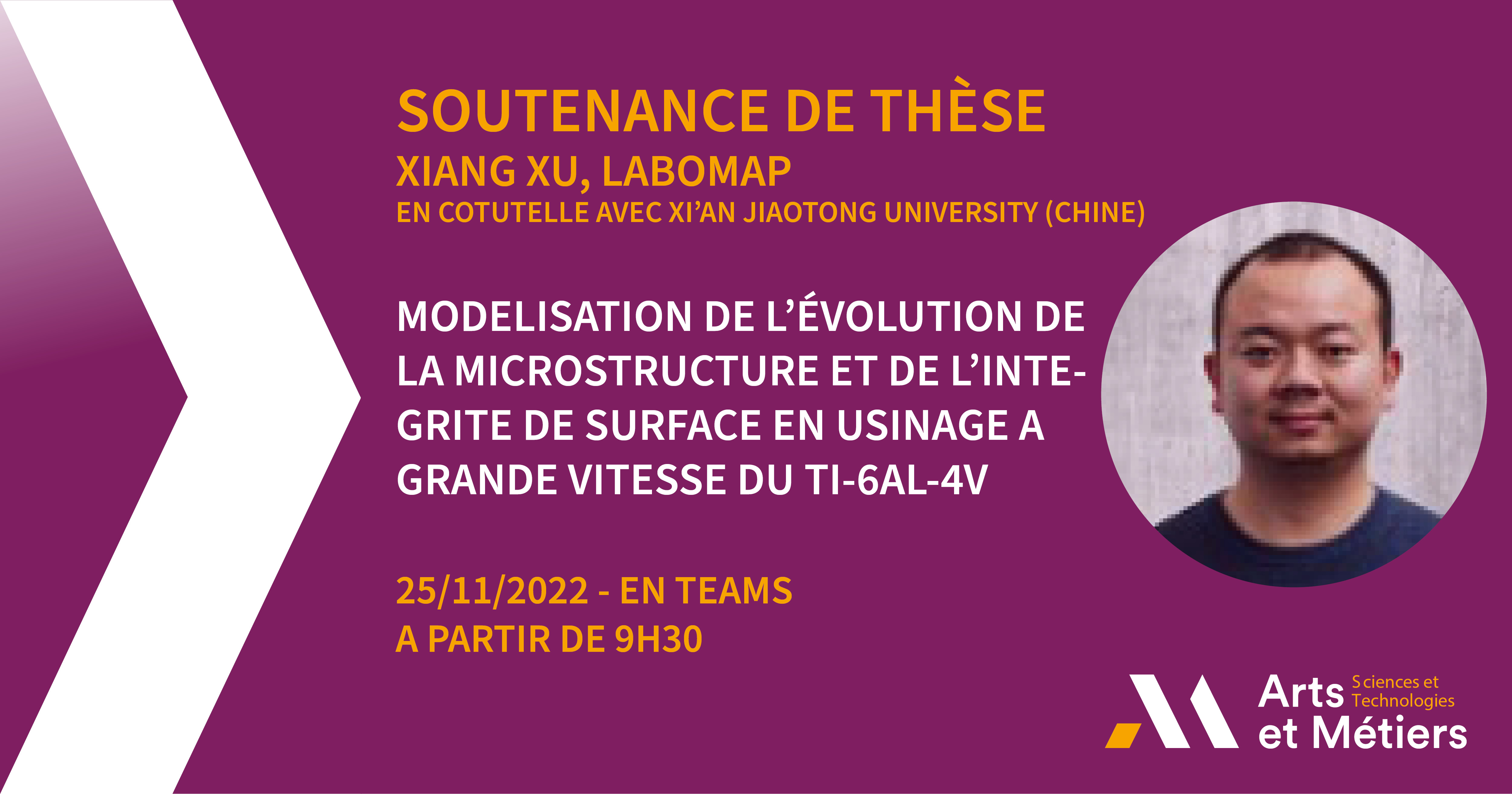
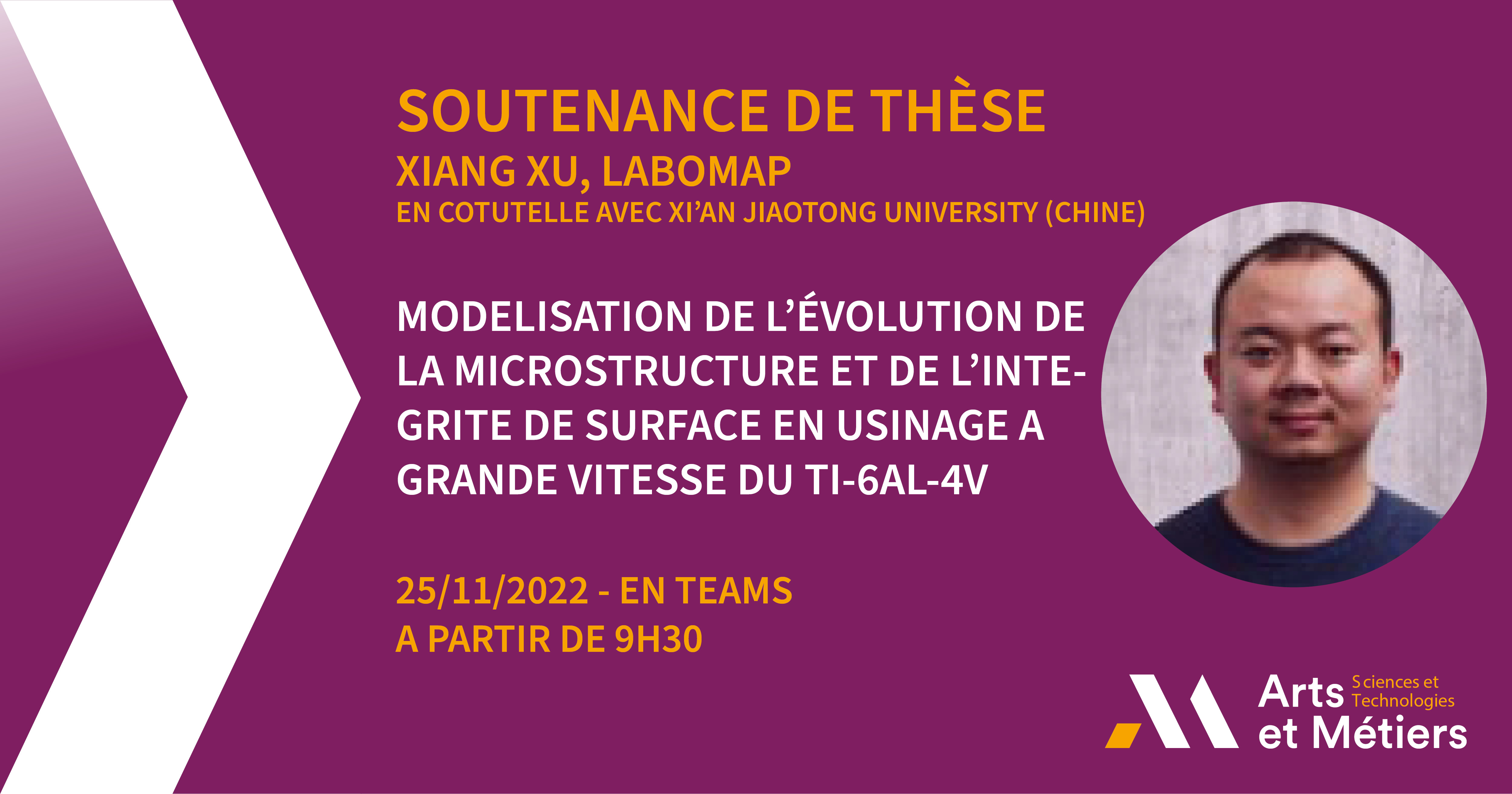
Xiang XU, PhD student at LaBoMaP, will defend his thesis entitled: "Modeling the Evolution of Microstructure and Surface Integrity in High-Speed Machining of Ti-6Al-4V"
Xiang XU completed a joint thesis between Arts et Métiers LABOMAP) and Xi'an Jiaotong University (China).
The thesis defense will take place on November 25, 2022, at 9:30 a.m. (CET time) via TEAMS.
Join the TEAMS meeting:
JURY MEMBERS
Rapporteurs
- Mr. Domenico UMBRELLO, Professor, University of Calabria
- Mr. Min WAN, Professor, Northwestern Polytechnical University
Examiners
- Mr. Mohammed NOUARI, Professor, University of Lorraine
- Ms. Madalina CALAMAZ, Associate Professor, Arts et Métiers
- Mr. Ke HUANG, Professor, Xi'an Jiaotong University
- Mr. Qinghua SONG, Professor, Shandong University
- Mr. Jun ZHANG, Professor, Xi'an Jiaotong University
- Mr. José OUTEIRO, Associate Professor HDR/Habil., Arts et Métiers
SUMMARY
The rapid development of the aerospace industry is driving the need to increase manufacturing productivity while maintaining or even improving part quality. High-speed machining (HSM) of difficult-to-machine materials such as titanium-based alloys is one way to achieve high productivity. To date, most research on surface integrity in machining has been based on phenomenological analysis and rarely involves theoretical analysis of the physical phenomena responsible for modifying the properties of the near-surface layer. In this research, the evolution of the microstructure and surface integrity induced by HSM of the Ti-6Al-4V alloy is studied using modeling and experimental approaches. A multiscale modeling approach combining finite element simulations using the CEL approach and the cellular automata method was used to simulate the evolution of the microstructure during machining, including in the machined surface and subsurface. The surface topography, plastic deformation, microhardness, and residual stresses in the machined surface and subsurface were also simulated, revealing the influence of the cyclic nature of the cutting process on these surface integrity characteristics.
KEYWORDS
Multi-scale modeling, High-speed machining, Ti-6Al-4V, Microstructure, Dynamic recrystallization, Surface integrity.
_________________________
We are pleased to invite you to the thesis defense of Mr. Xiang XU, entitled: "Modeling of Microstructure Evolution and Surface Integrity in High Speed Machining of Ti-6Al-4V alloy."
Xiang XU completed a joint supervision Ph.D thesis between Arts et Metiers Institute of Technology (ENSAM-LABOMAP) and Xi'an Jiaotong University (China).
The thesis defense will take place on November 25, 2022, at 9:30 a.m. (CET time) via TEAMS using the following link: Click here to join the meeting
Meeting ID: 346 825 012 231
Passcode: w7QB7g
JURY MEMBERS
Reviewer
- Mr. Domenico UMBRELLO, Professor, University of Calabria,
- Mr. Min WAN, Professor, Northwestern Polytechnical University
Examiners
- Mr. Mohammed NOUARI, Professor, University of Lorraine
- Mrs. Madalina CALAMAZ, Associate Professor, Arts et Métiers of Technology
- Mr. Ke HUANG, Professor, Xi'an Jiaotong University
- Mr. Qinghua SONG, Professor, Shandong University
- Mr. Jun ZHANG, Professor, Xi'an Jiaotong University
- Mr. José OUTEIRO, Associate Professor HDR/Habil., Arts et Métiers of Technology
ABSTRACT
The rapid development of the aerospace industry is the motivation for increasing manufacturing productivity while maintaining the same part quality or even improving it. High-speed machining (HSM) of difficult-to-cut materials such as titanium-based alloys is one way to achieve high productivity. So far, most research work on surface integrity in machining is based on phenomenological analysis and rarely involves a theoretical analysis of the physical phenomena responsible for the modification of the near-surface layer properties. In this research work, the microstructure evolution and surface integrity in HSM of Ti-6Al-4V alloy are investigated using modeling and experimental approaches. A multiscale modeling approach combining finite element simulations using the CEL approach and the cellular automata method allowed the microstructure evolution during machining to be simulated, including in the machined surface and subsurface. Surface topography, plastic strain, microhardness, and residual stresses of the machined surface and subsurface were also simulated, revealing the influence of the cyclic nature of the cutting process on these surface integrity characteristics.
KEYWORDS
Multiscale modeling, High Speed Machining, Ti-6Al-4V, Microstructure, Dynamic Recrystallization, Surface Integrity.