Since 2013, the Design, Manufacturing, and Control Laboratory (LCFC) at the Arts et Métiers campus Arts et Métiers Metz has been developing an innovative process for manufacturing massive composite parts using additive manufacturing and forging. This innovative project is being carried out in collaboration with AMValor, Setforge (Farinia Group), andthe Composite Integrity Welding Institute.
An environmental issue
Automotive and aerospace manufacturers are subject to regulations requiring them to reduce greenhouse gas emissions. One solution is to make vehicles lighter. To do this, they are considering developing structural parts such as suspension systems using a lighter material that is just as strong (elasticity, tensile strength, toughness, etc.).
While composite materials can meet these specifications, the conditions under which they are used do not currently allow for the production of large structural parts at satisfactory rates.
Hence the interest in developing a new manufacturing process such as the EPITHER process, which the LCFC and its partners are working on. Three patents have already been filed for this process, which will enable partners to develop their product range with added value that cannot be achieved using conventional processes: high continuous fiber content (up to 60%), very low porosity (close to zero depending on conditions), ability to produce large series, etc.
Preform manufacturing: additive manufacturing
When the project was launched, studies confirmed its feasibility: yes, it is possible to manufacture massive forged composite parts. And at competitive production rates!
For four years, work focused on different fiber placement processes for manufacturing the preform: embroidery, robotic winding, and 3D printing. Research is now centered on the latter process.
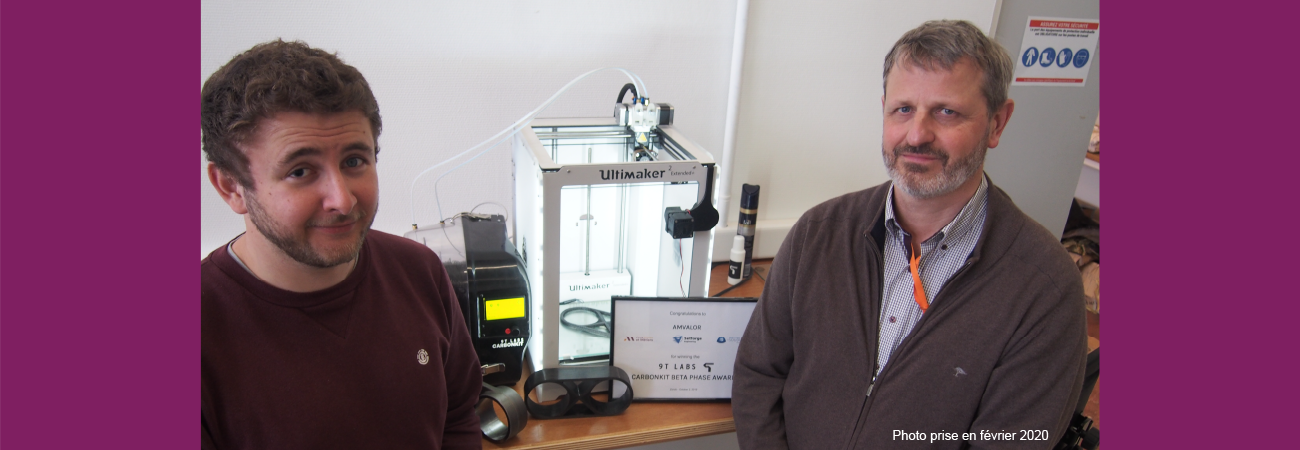
The use of long fibers and control over their orientation are essential for obtaining highly resistant composite products. This control is achieved through 3D printing and was recognized with the "Carbonkit beta phase award" presented in October 2019 in Zurich by 9T labs, the company that markets equipment for 3D printing continuous carbon fiber parts and thermoplastic matrices.
Numerical simulation and product/process interactions
At the same time, engineers and research professors are studying the characteristics of solid composites, i.e., the material health of the parts produced (presence of defects, material structure, fiber orientation, etc.), as well as how they react to mechanical stress. To do this, they are turning to digital technology to develop simulation models that are as close to reality as possible.
Current studies focus on product/process interaction: to what extent do manufacturing parameters influence the product? What values enable high, stable part quality that can be reproduced regardless of the type of part? This data will be used to determine which manufacturing parameters to adjust in order to obtain a part with the expected mechanical and geometric properties.
Essential steps before industrialization
All these steps are essential before the process can be used in industry.
In order to produce parts differently, manufacturers need assurances: assurance that the new process will enable them to maintain their production rates, and assurance that the new parts manufactured will fulfill their role. There is no question of installing a part in a car or an airplane that does not meet the specifications.
This is the work of research laboratories such as LCFC and its commercialization subsidiary AMValor.
The work carried out has already made it possible to produce functional parts. The next step is to set up a pilot line which, in addition to producing parts, will be used to optimize the future industrial tool.
Scientific publications
- Lecture given in 2017 at the ESAFORM conference in Dublin : "Structural investigation of a new composite process."
- Thesis work by Philippe Mayer (2018).
- First patent filed in 2011.
- Lecture given in 2020 at ESAFORM 2020 in Cottbus, Germany: "Forging C/Thermoplastic Printed Composite, Shaping Parameters Impact."