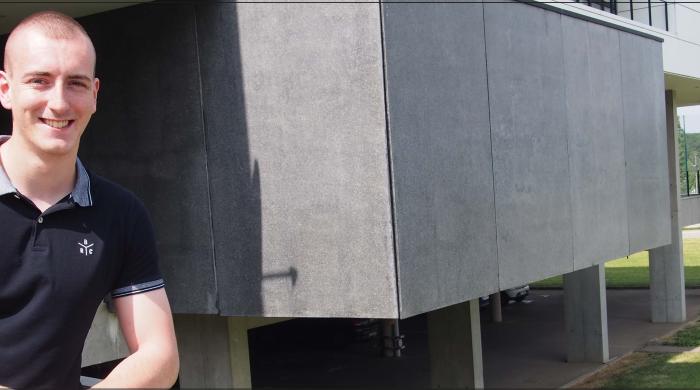
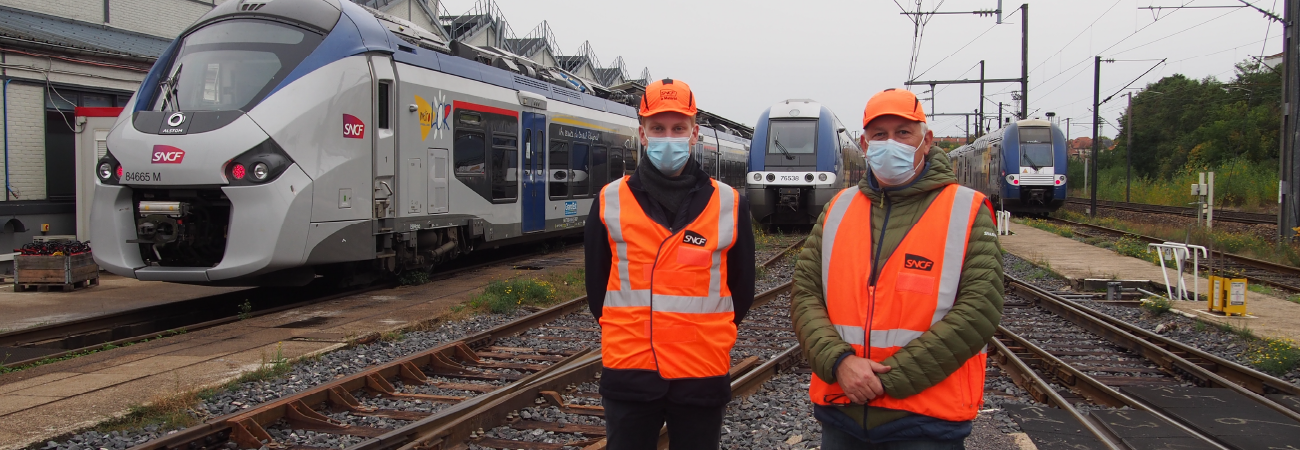
The Specialized Engineering Program, which is a work-study program, is based on a close relationship between a student, a company, and Arts et Métiers. Mathieu Laurent, a third-year student in the Industrial Equipment Design and Operation program at the Metz campus, is an apprentice engineer at the SNCF's Technicentre Grand Est. He answered a few questions alongside Bernard Ham, his company mentor and Director of Delegated Operations at the SNCF.
Work-study programs: a no-brainer?
Mathieu Laurent: It wasn't necessarily so, as this is the first time in my education that I've done a work-study program! But for my final years of study, I think it's really the best choice.
It allows me to build up strong theoretical and technical skills alongside practical skills.
In my opinion, this is one of the best ways to enter the professional world. The work-study program allows me to confirm my choice of career path. Today, I am able to effectively plan for my future.
Bernard Ham: At SNCF, we have historically worked extensively with work-study programs due to the specific nature of our jobs. It's beneficial for recruitment at all levels and in all areas.
How does a student apprentice fit into the company?
ML: During your first few months at a company, you discover, observe, and learn to participate in discussions and company life. It's really at the beginning of the work-study program that you realize how well you've integrated. Personally, I'm lucky to have very good relationships with my colleagues on a daily basis.
I appreciate seeing the exchange that develops between what we can bring to the company and vice versa. Especially when, like me, you are part of a department and a team that pushes you to improve, it's rewarding. I feel like I'm part of the company's life!
BH:
Mathieu established his legitimacy in the first two years with smaller, more structured projects.
He has made himself known to the site's representatives. Now, whether for internal meetings or with external partners, he mostly goes there alone.
How do classroom learning and workplace experience complement each other?
ML: Naturally, the work-study program allows me to draw parallels between what I learn at school and in the workplace. As part of my duties at the company, I work on managing internal investment projects, which requires me to develop a range of technical and managerial skills. In this regard, I appreciate being able to observe a more in-depth analogy of certain concepts covered at school.
On the other hand, when I am atArts et Métiers the opportunity to participate in a variety of practical work. For example, I can think of the practical work I did in fluid mechanics. At first glance, I might think that these concepts will not be useful in my work, but quite the opposite is true! Today, we need to tackle project management issues by drawing on a wide range of strong technical skills.
In addition, constant communication between corporate and academic mentors enables a real transfer of skills between the school and the company. The aim of this dynamic is to progress from a senior technician level to that of an engineer.
What support does a student apprentice receive within the company?
BH: We adapt to the milestones defined with Arts et Métiers proposing projects that allow us to validate the various skills acquired: management, reverse planning, meeting facilitation, etc.
For example, in his first year, to help him learn about the company, we gave Mathieu small projects that allowed him to integrate by discovering his environment.
From the second year onwards, we entrusted him with increasingly important projects to enable him to gradually develop his technical skills and put his learning into practice.
The sequencing of the 1st to 3rd years and the dual Arts et Métiers tutoring enable students to change their approach and successfully complete their final year project.
What is this final year project?
ML: At the SNCF site in Metz Sablon, numerous series of TER trains are maintained and require technical cleaning of various components (engines, bogies, axles, air conditioning, etc.). Under the current organization, this is carried out in the dedicated maintenance workshop. My final year project consists of studying a track dedicated to these cleaning operations with the aim of industrializing it and making the workshop available for preventive and corrective maintenance.
Work-study program and dual degree in engineering management
He thus benefits from several seminars throughout the year during which he develops his project management skills, alongside other engineering students from the Metz Technopôle.