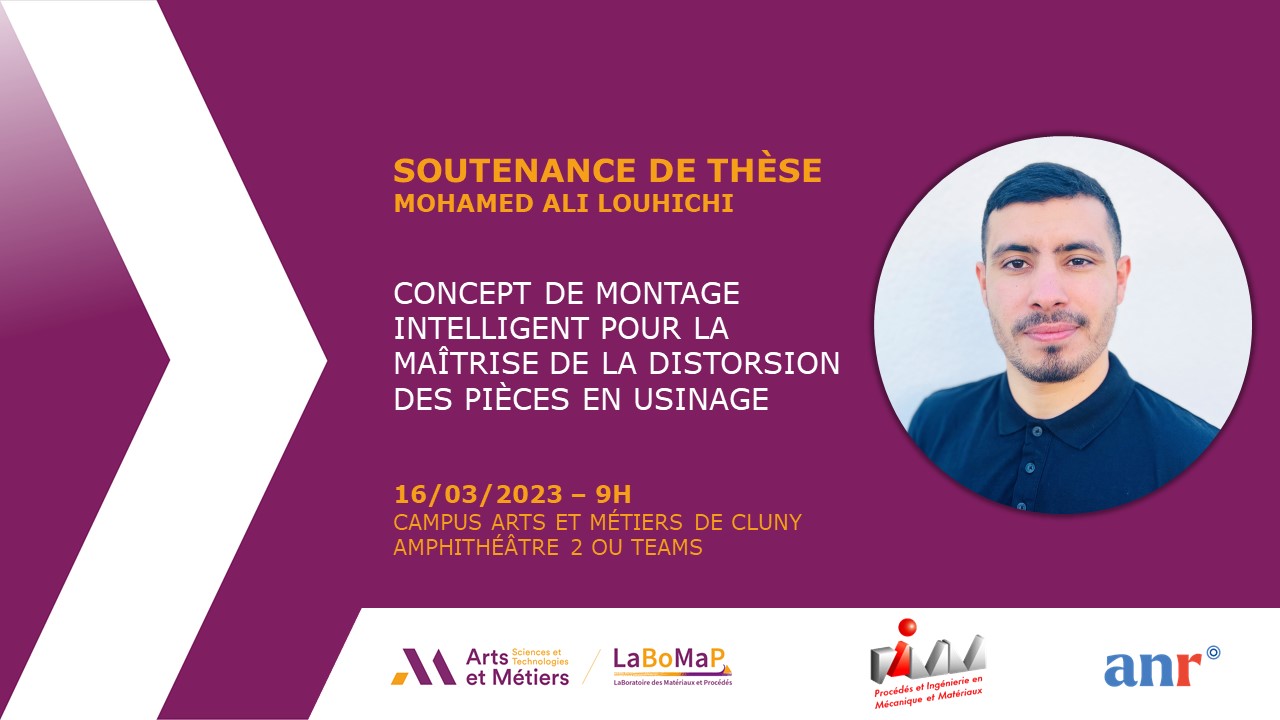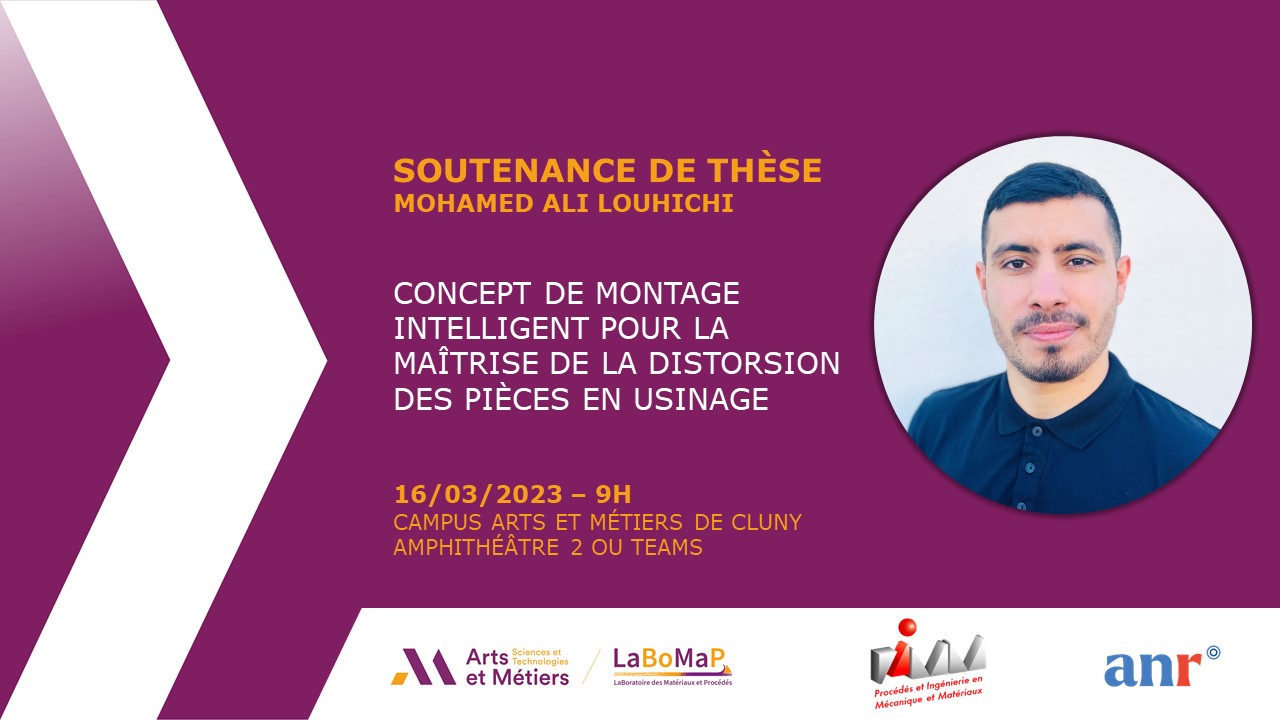
Mohamed Ali LOUHICHI, PhD student atLaBoMaP,defends his thesis on: "Intelligent assembly concept for controlling distortion in machined parts."
This defense can be followed remotely via TEAMS.
Thesis supervisors: Gérard Poulachon and Philippe Lorong
Co-supervisor: José Outeiro
Members of the jury
Rapporteurs
- Katia Mocellin, University Professor, Mines Paris, PSL University
- Mathieu Ritou, Associate Professor, Nantes University - LS2N
Examiners
- Perdro Arrozola Arriola, University Professor, Mondragon University, Spain
- Hélène CHANAL, Senior Lecturer, Sigma, Clermont
- Gérard POULACHON, University Professor, LaBoMaP, Arts et Métiers
- Philippe LORONG, University Professor, PIMM, Paris
- José OUTEIRO, Senior Lecturer, LaBoMaP, Arts et Métiers
- Eric MONTEIRO, Associate Professor, PIMM, Paris
Guest
- Alexandre BROSSE, Doctor of Engineering, FRAMATOME
Summary
For thin parts, whose final shape is obtained by machining, it is common to observe, after deburring, deformations that are incompatible with the future use of these parts. These deformations are caused by the release and redistribution of initial stresses during machining and deburring. These initial stresses are generated by manufacturing processes applied prior to machining, such as rolling and heat treatment. This work considers an approach based on numerical modeling to anticipate and minimize these deformations, thereby saving time and money. The approach uses in-situ measurements on 7075-T6 aluminum alloy parts. It is based in particular on a meta-model using a database of residual stress profiles derived from a design of experiments based on the uncertainties and sensitivities of the simulation data of the heat treatment applied to the part prior to machining. Next, singular value decomposition (SVD) is used to represent the new combination of residual stresses. This combination is updated after each machining step using optimization based on actual distortion measurements. This meta-model is then used to predict the exact deformation of the part after deburring by observing the deformations of the part during machining. This prediction of deformations makes it possible to correct the tool path during the final machining pass using an instrumented setup to improve the final shape of the part after deburring.
Keywords
Residual Stresses, Distortion, Numerical Simulation, Model Reduction, Al 7075.
PRACTICAL INFORMATION
Participate from your computer, mobile app, or room device
Meeting ID: 341 045 260 494
Passcode: 9zJEa2
Download Teams | Join on the web