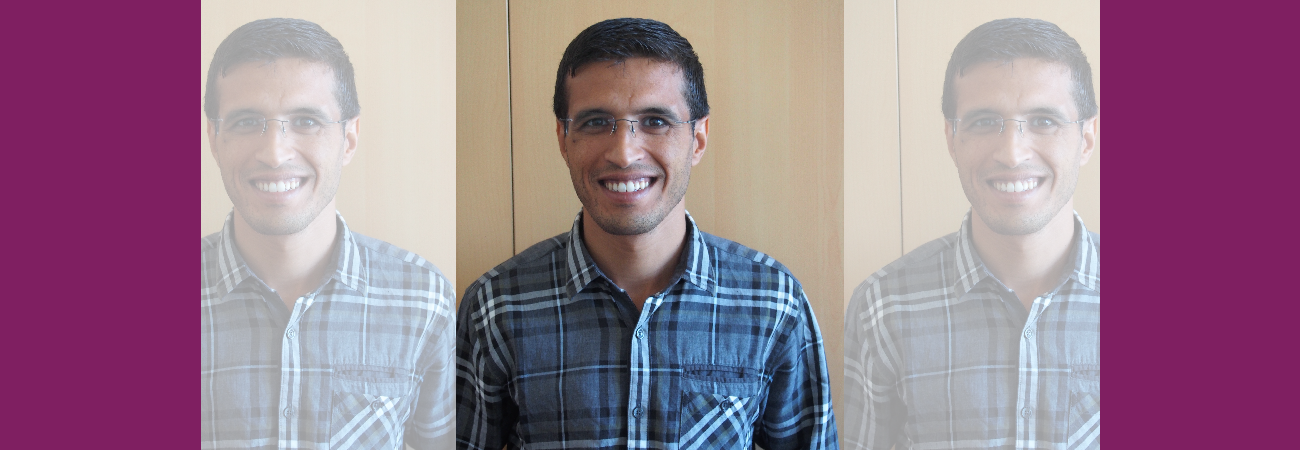
Mohamed Jebahi is a lecturer and researcher at the Metz campus of the Laboratory for the Study of Microstructures and Materials Mechanics. His first ANR Young Researchers (JCJC) project began on January 4, 2021, and will run for four years.
What is your background?
I completed my thesis atthe Institute of Mechanics and Engineering (I2M) at the University of Bordeaux, under the supervisionof Ivan Iordanoff, Frédéric Dau, and Jean-Luc Charles. I then went on to complete two postdoctoral fellowships: the first at Laval University in Quebec City and the second at the Arts et Métiers campus Arts et Métiers Bordeaux. I joined the Metz campus in 2016 as a senior lecturer.
How did you set up your ANR JCJC project?
It's difficult to set up projects like this without being familiar with the requirements and selection criteria. Fortunately, this wasn't my first application!
For my efforts, I relied on the Arts et Métiers Research Department Arts et Métiers the expertise of my partners. The biggest challenge was figuring out how to properly highlight the project's concept and show that it would represent a major breakthrough in research.
What is your project about?
Numerous studies reveal small-scale specificities (known as size effects) in the inelastic behavior of metallic materials. Given the growing trend toward miniaturization, the correct modeling of these effects has become a necessity in several fields of engineering. To model them, promising approaches have been developed, known as non-local approaches based on gradient plasticity.
However, under certain complex loads, these approaches reveal a phenomenon unknown in the real world: gaps or elastic jumps. The physical reality of these gaps divides the scientific community between those who consider them possible and those who see no physical reason for their existence, thus calling into question the theoretical basis of certain gradient approaches.
My project aims to resolve this ambiguity and provide an indisputable answer to the question: are elastic gaps physical? It is entitled: "Experimental and numerical investigation of elastic gaps in strain gradient plasticity theories" or "SGP-GAPS" (SGP: Strain Gradient Plasticity).
What are the steps involved?
First, in order to study the physical reality of the elastic gap phenomenon, it is necessary to fully understand this phenomenon, its theoretical origins, and the conditions under which it occurs within the framework of existing gradient theories.
Next, original small-scale experiments will need to be conducted, involving non-proportional loading for the first time, as well as advanced simulations based on discrete dislocation dynamics.
The experimental and numerical results will also be used to develop the first plasticity models with sufficient accuracy for industrial applications.
What are the expected outcomes?
Thanks to this project, the mystery surrounding the physical reality of elastic gaps will finally be solved. This will enable scientific efforts to be unified and focused on gradient theories involving, or not involving, elastic gaps.
The gradient models that will be developed as part of the project will open the door to new industrial applications, such as the digital optimization of material microstructures. Although this latter application is not included in the project, it is envisaged as a future extension.
Who are the partners?
The laboratory leading the project is LEM3. Two other members of this laboratory are involved, namely Jean-Sébastien Lecomte and Christophe Schuman, both from the University of Lorraine. The project also involves the Materials Center through Samuel Forest and the Materials and Processes Science and Engineering Laboratory (SIMaP) through Marc Fivel. Both are CNRS research directors and world leaders in their fields. We are very fortunate to have them on board for this project!
In addition to our permanent members, a doctoral student and several Master of Science students Master of Science joining us soon.
What advice would you give to researchers who want to start an ANR project?
You have to believe in your abilities and go for it! No matter the outcome, you always win! I admit that a negative result is very frustrating at the time (speaking from experience after several unsuccessful attempts!). But you have to remember that what doesn't kill us makes us stronger. You're not wasting your time because you're improving your project management skills. If I had to do it all over again for the same results, I would do so without hesitation.