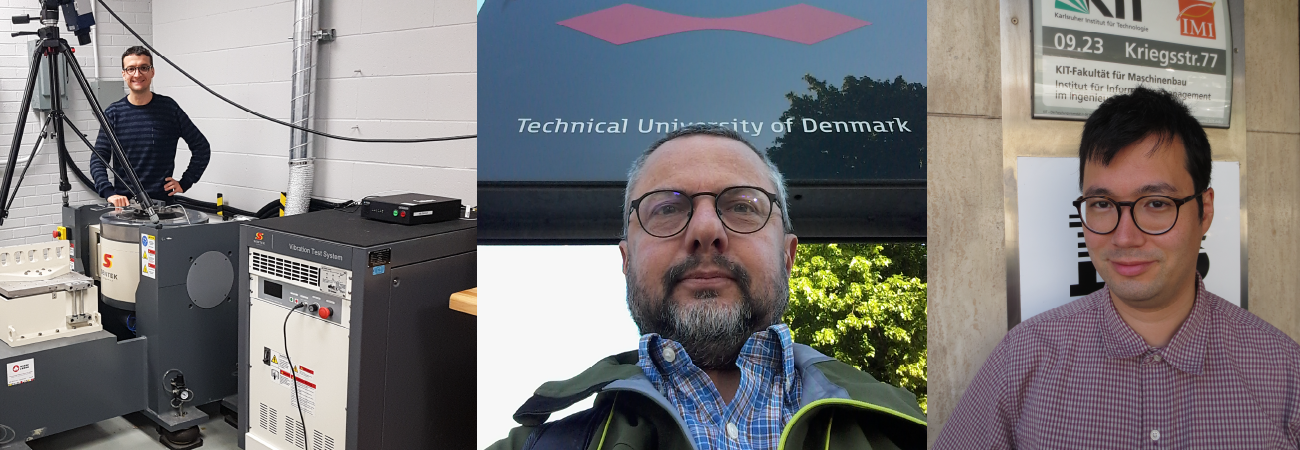
Jean-Rémy Chardonnet, Etienne Pessard, and Jean-Yves Dantan are professors and researchers at Arts et Métiers. Last year, they spent a year each in Germany, Canada, and Denmark. Here's a look back at their immersion abroad.
All three took advantage of a Leave for Research or Thematic Conversions (CRCT). This type of leave allows a teacher-researcher to devote themselves to a research topic for a period of six to twelve months.
In Germany: the Karlsruhe Institute of Technology
Jean-Rémy Chardonnet is head of the virtual/augmented reality division atthe Franco-German Institute for the Industry of the Future, whichArts et Métiers in partnership with KIT (Karlsruher Institut für Technologie). It was therefore only natural that he chose this German institution to develop a research collaboration.
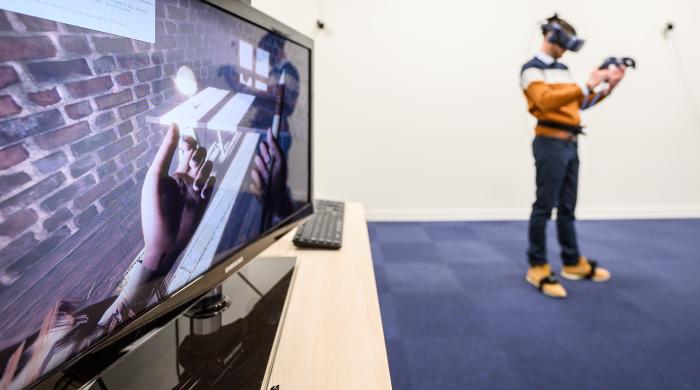
" I worked on customizing interaction in the virtual environment, " explains Jean-Rémy Chardonnet. " Thanks to an exchange grant fromthe Franco-German University, I went with one of my doctoral students who worked on studying intelligent navigation in virtual environments, drawing inspiration from the German approach to the subject. "
Jean-Rémy Chardonnet took advantage of his stay to work on two European projects focused on developing personalized interactive technology that would give as many people as possible access to scientific and technical knowledge. The results will be announced in November.
But his stay also enabled him to establish new collaborations with Prof. Jivka Ovtcharova, director ofthe IMI institute (Arts et Métiers partner laboratoryArts et Métiers KIT). She is currently spending two months at the Institute in Châlon-sur-Saône, where Jean-Rémy Chardonnet is based.
" In fact, my presence in Germany has enabled us to work closely together to organizethe summer school on artificial intelligence, from October 19 to 23, 2020, in Karlsruhe, and a special scientific session at the IEEE International Conference on Artificial Intelligence and Virtual Reality, which will take place from December 14 to 18, 2020, in Utrecht (Netherlands), on the intelligent digital twin.," says Jean-Rémy Chardonnet.
" Working with and at a foreign partner, almost exclusively throughout this year, has been extremely rewarding, " recalls Jean-Rémy Chardonnet. " After this experience, I obviously want to continue working with KIT, but also develop more international partnerships through, for example, European projects. "
In Canada: Polytechnique Montréal
Etienne Pessard has left for Canada to start a new research topic and explore opportunities for developing partnerships withthe École Polytechnique de Montréal: " After 10 years as a senior lecturer at the Angers campus, it was a great opportunity to take a step back from my research and open myself up to other topics."
Thanks to his presence on site, Etienne Pessard was able to develop his skills in multi-axial vibration fatigue testing and raise the profile of his affiliated laboratory at Arts et Métiers, LAMPA: "In particular, I joined REGAL (Quebec's aluminum research center) as a collaborating member and presented my work at Polytechnique Montréal's Institute for Innovation and Design in Aerospace (IICAP)."
Today, Etienne Pessard wants to continue working with Polytechnique Montréal to learn more about other practices: " I've learned a lot about conducting vibration tests for fatigue characterization. "
In Denmark: the Danish Technical University
Jean-Yves Dantan was in Copenhagen, Denmark, at DTU (Danish Technical University), in the Mechanical Engineering - Design and Production department. His CRCT was pre-designed with DTU researchers: " In addition to strengthening my skills in robust design, model uncertainty, and uncertainty and metrology, I also wanted to enrich myself with a different approach to teaching and research. "
That is why, during his stay, Jean-Yves Dantan collaborated on research while also observing teaching methods within their Learning Lab. He drew on his observations to produce a report on the teaching methods used by DTU teachers. He has already begun testing a problem VS project approach: " When you give a student a project, you usually spell out all the problems for them. With this approach, you set an objective, and the student has to identify the problems to be solved and organize themselves accordingly. The assessment grid is developed jointly with the student. "