MADMAN: Additive Manufacturing Engineering - Advanced Design and Manufacturing
Campus
Arts et Métiers Campus Arts et Métiers Paris
Objectives
- Provide students with the skills necessary to design products suitable for additive manufacturing, with an emphasis on design and modeling aspects.
- Provide students with knowledge of all additive manufacturing processes (polymers and metal), their design rules, advantages, and limitations.
- Discover the Design For Additive Manufacturing (DFAM) method
Program
Design Block (approximately 70 hours):
Module 1 (11 hours): Creativity (F. Mantelet): Idea generation techniques and creative approaches that can be used to design innovative parts for additive manufacturing.
Module 2 (12 hours): Product Life Management (PLM) (F. Segonds): Basic principles of product life cycle management and how to apply them to the design of parts for additive manufacturing.
Module 3 (26 hours): Topological optimization (P. Lorong; E. Monteiro): Teaching related to design algorithms for optimizing the geometry of parts for additive manufacturing using specific CAD software.
Module 4 (8 hours): Reverse Engineering (I. Koutiri): Tools related to reverse engineering for designing a part based on an existing manufactured part.
Module 5 (10 hours): Surface design (I. Koutiri): CAD surface design applied to additive manufacturing.
Manufacturing block (approx. 60 hours):
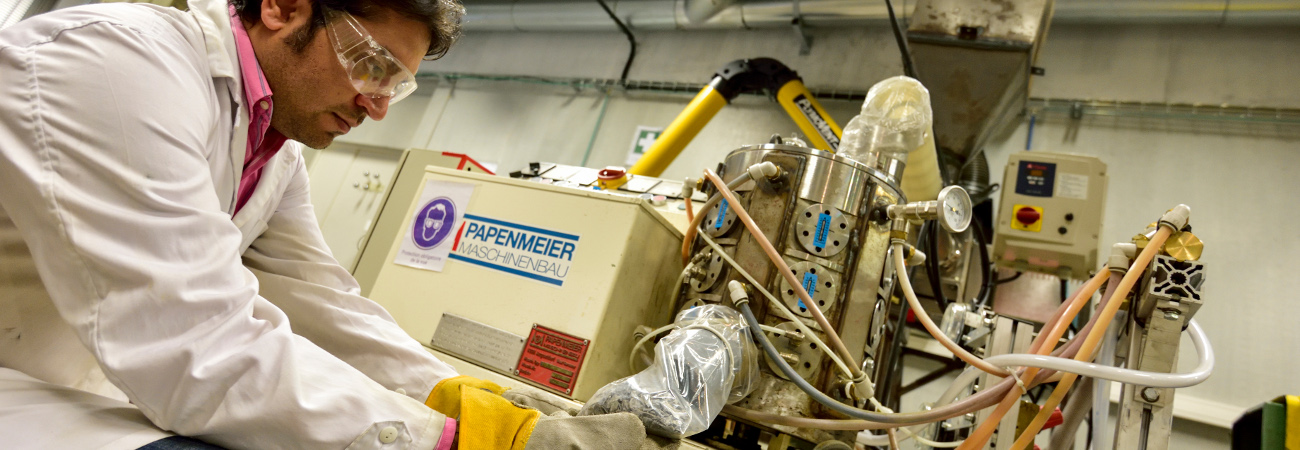
Module 6 (23 hours): Additive manufacturing for polymer materials (S. Roland; I. Koutiri; E. Richaud): Presentation of polymer materials and associated processes.
Module 7 (12 hours): Additive manufacturing for metallic materials (M. Schneider; M. Dal): presentation of laser processes for metallic additive manufacturing.
Module 8 (24 hours): Quality and health of printed parts (N. Harcouët; I. Koutiri): Artificial intelligence tools and algorithms for quality control of parts. Health and fatigue of parts in additive manufacturing.
Project block (approximately 3 p.m.):
Theme: Eco-design for additive manufacturing or additive manufacturing for eco-design. How can these two concepts be closely linked? Student bibliographic project on eco-design.
Assessment: Weighted average grade per module: midterm tests, individual assignments, lab grades, and project defense.
Industrial and academic research conferences (5 hours)
Lectures given by figures from the industrial world and academic research on their issues and/or practices relating to these processes.
Assessment methods
Grade per module: midterm tests, personal assignments, lab grades, and final exam.
Final grade: weighted average of each module.
Benefits of the training
Specialized training in additive manufacturing covering multiple sectors.
Project examples
- Design and production of industrial parts with optimized geometry
- Development of a parallel cable robot for the direct manufacture of large parts
- Manufacture of models and demonstrators for science education
- Topological optimization of lightweight structures for aeronautics
- Development of a structured metal foam for shock absorption
- Feasibility study of laser sintering of hydroxyapatite for the manufacture of prostheses
- Multimaterial assemblies using laser processes
Practical information
- Course language: French
- Period: Off-peak semester
- Number of hours: 150
- ECTS credits: 13
- Responsible: Sébastien Roland, Head of the UEE
Targeted companies
Saffron, Thales, Sculpteo, Prodways,….
Contact
Sébastien Roland, Head of the UEE
Keywords
#AdditiveManufacturing #DFAM