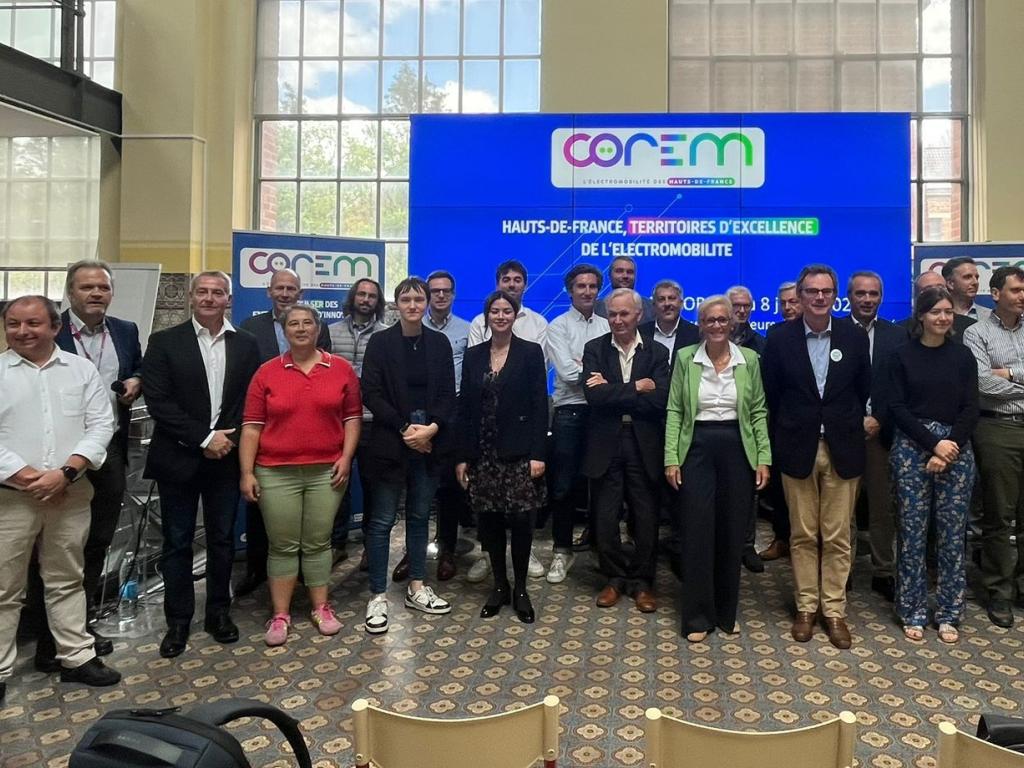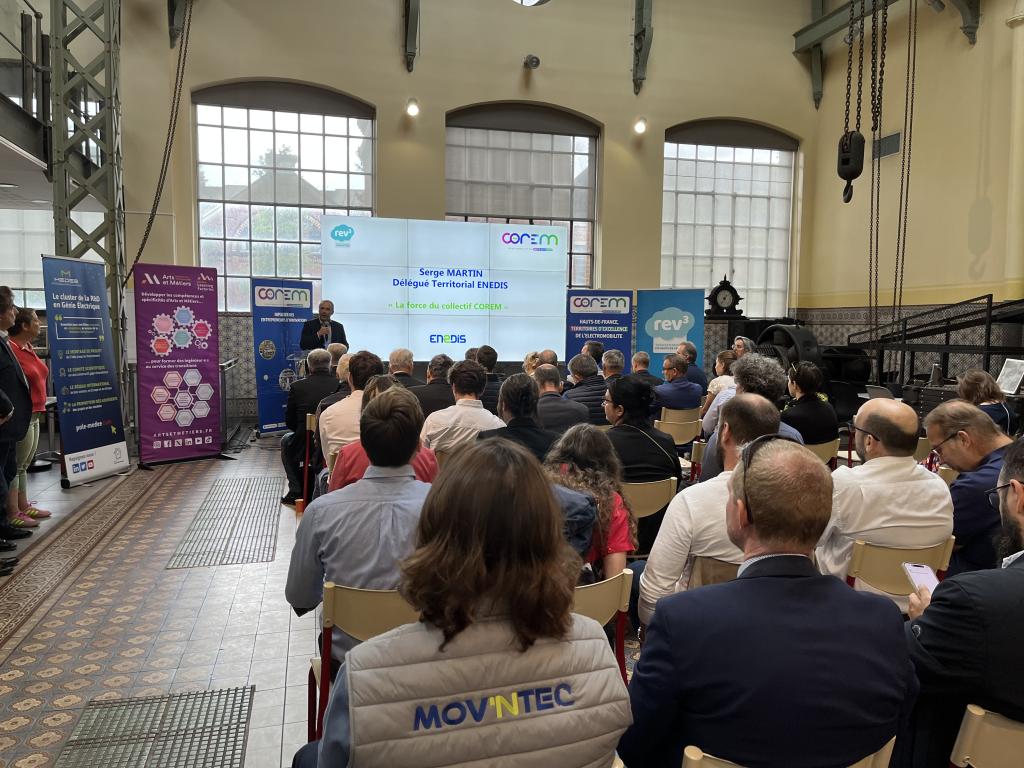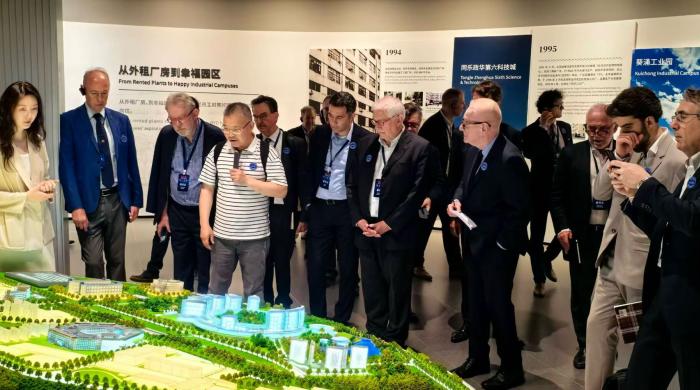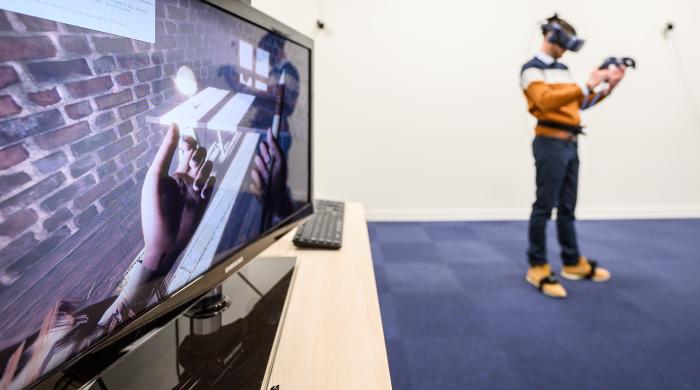

On Tuesday, July 8, 2025, the Arts et Métiers campus Arts et Métiers Lille had the honor of hosting the COREM Committee, bringing together numerous partners from the Hauts-de-France region with a common goal: to make electric mobility a lever for innovation, economic development, and environmental transition.
Companies, local authorities, laboratories, universities, and regional institutions came together to exchange ideas, debate, and jointly shape the future of electromobility within an exemplary framework of cooperation.
The COREM committee: a morning of meetings, innovations, and perspectives for the energy transition in Hauts-de-France
COREM: a strategic collective dedicated to electromobility
COREM (Collectif Opérationnel Régional de l’ÉlectroMobilité) acts as a bridge between research, education, and industry. Its mission is to promote the emergence of concrete projects, mobilize skills, and bring together stakeholders to build a regional sector of excellence and innovation in the field of electromobility.
The work undertaken is structured around several thematic groups:
- Prospective: led by ADEME, with a forward-looking approach based on the Transition 2050 scenarios, focusing on future mobility (electrification, fuel efficiency, vehicle weight, new uses, etc.).
- Innovation: focusing on IAPE (Innovations d’Accès aux Petits Engins, or innovations for access to small vehicles), intermediate vehicles, and new powertrains.
- Employment and skills: challenges related to battery gigafactories, anticipating training needs (from operators to engineers), with a regional Marshall Plan for employment.
- Funding: identifying and structuring support mechanisms for innovative projects with the backing of the Region and European funds.
Intermediate vehicles: an innovative response to new uses
Among the flagship projects, emphasis has been placed on intermediate vehicles, a new category between bicycles and cars. They offer simplicity, accessibility, and fuel efficiency, while meeting the challenges of everyday travel.
Several types of vehicles were presented:
- MOV'NTEC Mobility presented its Galibot model, a light electric utility vehicle that is already on the market and was designed mainly in the Hauts-de-France region. With a range of 50 to 60 km, it can be recharged in 2.5 hours and is aimed at industrial and professional markets.
- ADEME and its partners are supporting the industrialization of light vehicles for the general public and their testing in different regions. The "Tour de France of intermediate vehicles" study is currently underway, with awareness-raising initiatives (e.g., educational signs in Loos-en-Gohelle and in the 7 Vallées community of municipalities).
Scientific and technological excellence in Hauts-de-France in action
The subject of electromobility represents a complete ecosystem, including research and optimization topics such as:
- Electricity grid and charging infrastructure
- Drive train, energy storage, and smart energy management
- Behavioral research (conducted by humanities and social sciences laboratories) to analyze usage patterns and adapt innovations to driver behavior
As part of the COREM collective, the various partners are mobilizing cutting-edge testing resources, from battery prototyping to driving simulators, integrating interactions between vehicles, drivers, and networks.
For example, L2EP, the electrical engineering and power electronics laboratory, part of whose teams work at the Arts et Métiers campus Arts et Métiers Lille, presented the results of the GROUPEE 4.0 project carried out with Partenord Habitat in 2021 to the COREM committee. The project involved the deployment of a bidirectional charging station in a residential parking lot.
The results of the deployment of this project have notably shown that:
- A reduction in the building's energy bill: 9 to 13%
- Reduction in CO₂ emissions: up to 27%
- Vehicle-to-Grid operation: the vehicle becomes an active player in the energy network
COREM, a partnership between research, industry, and the region: a regional model
COREM embodies a rare dynamic of cooperation, where the worlds of research, education, and industry work together to develop tailor-made solutions:
- Universities and grandes écoles, including Arts et Métiers, provide training for future engineers and researchers in addition to their research activities, while adapting their content to industrial needs.
- Innovative companies such as Mecaware, DBT, Ramery Mobility, and EnerSys are developing concrete solutions, often originating from or supported by laboratories in the region.
- The Electromob consortium, led by ARIA Hauts-de-France, brings together 40 industrial and academic partners to structure a sustainable European battery industry.
All stakeholders aim to train 13,000 people by 2030, directly addressing the future needs of businesses in the field of electromobility, in order to train the technicians and engineers of tomorrow to meet the needs of the industry of the future.
A collective ambition for regional leadership
The success of the transition to sustainable mobility depends on a shared conviction.
"We will not win against each other, nor without each other, but together."
— Frédéric Motte, president of Mission Rev3
COREM demonstrates the power of collective action in the Hauts-de-France region, bringing together all links in the chain—from fundamental research to market launch—with a clear goal: to make the region a hub of innovation and leadership in electromobility, in the service of decarbonization.
For Arts et Métiers, electromobility is a research topic, but also a training topic, which is fully in line with the institution's sustainable development and social responsibility policy. Committed to energy transition for many years, it actively contributes to the work of COREM by mobilizing its laboratories, teacher-researchers, and students on these topics.
Thank you to the organizers and partners of COREM, in particular Pôle MEDEE, Mission REV3, and ENEDIS, for their trust in organizing and hosting this event. Congratulations to the L2EP teams for their dynamism and the quality of their research work.