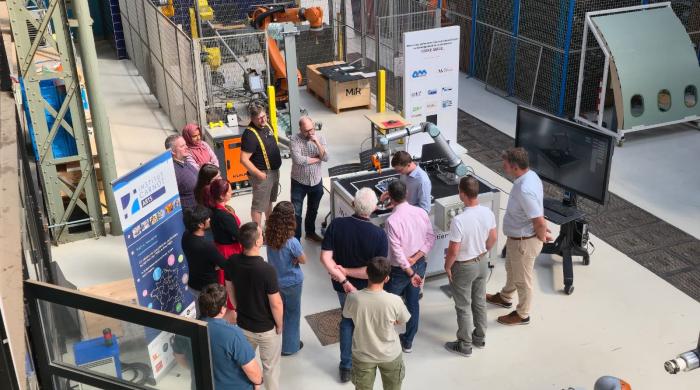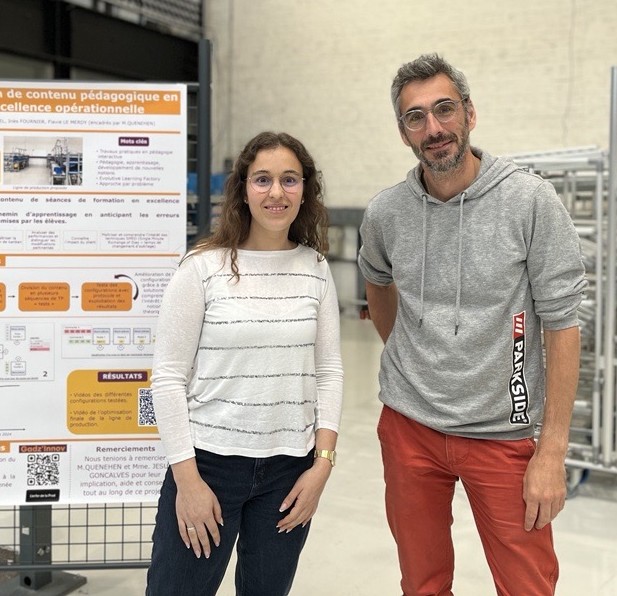
At the heart of the ELF project "Towards the robotization of processes" on the Lille campus, the assembly line, part of the LISPEN laboratory, is a concrete example of human-robot cohabitation within a platform. Ana Sofia Jesus Gonçalves and Anthony Quenehen explain.
The assembly line, part of LISPEN at the heart of the ELF project "Towards the robotization of processes" on the Lille campus
What investments have been made?
The initial investment was made by the Arts et Métiers foundation Arts et Métiers finance equipment purchases worth over €80,000 (workstations, parts for assembly, logistical resources) but above all to recruit an educational engineer.
Today, the platform is funded through calls for educational projects financed by the campus or the ELF activity.
The laboratory continues to develop educational resources, such as the purchase of robotic accessories and the creation of an educational space integrated into the platform.
Part of the operating budget is also covered by our partnership activities and continuing education initiatives.
What are the educational benefits?
We naturally adopted a learner-centered pedagogical approach, including for topics related to the integration of innovative technologies.
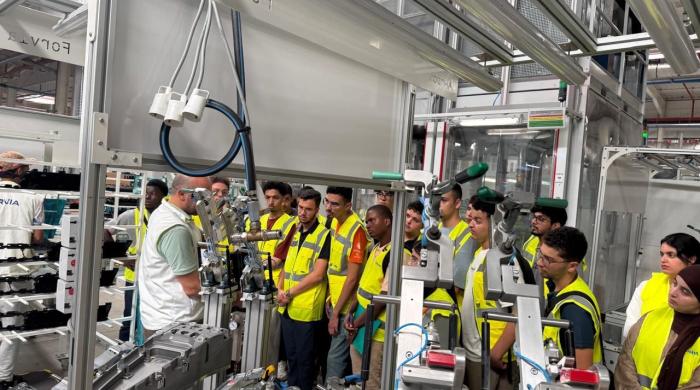
We wanted to create a credible immersive learning environment with exploratory teaching sequences where our students would evolve with a high degree of autonomy and learn through experimentation. This made sense for a discipline such as Lean Manufacturing, whose models are essentially empirical.
Beyond the educational benefits, this engaging approach allows students to grasp the soft skills needed to manage production teams. They take turns playing the roles of operators and supervisors in a production environment that they develop throughout the sequence, with the goal of generating operational performance while improving working conditions.
How Evolutive Learning Factories the Evolutive Learning Factories project Evolutive Learning Factories teaching activities?
The transition of instructional sequences to the Learning Factory was one of our initial priorities. With the ELF, we involve students as co-designers of the lab sessions. In fact, these sequences are developed based on projects carried out with groups of 2A and PJE students.
Students thus help build the practical work sessions for future cohorts.
This year, the projects carried out with students focused on a longer and more ambitious learning sequence. Thanks to this, we are now able to offer a training session lasting approximately 3 to 4 days if the full scenario is implemented.
This sequence was tested by a team of students during the Gadz’innov challenge on June 10, 11, and 12. This “real-world” validation will allow us to offer the sequence as continuing education and to adapt it into several modules that can be integrated into the Grande École program (PGE).
Current areas of development include the integration of innovative technologies, such as collaborative robotics and autonomous mobile robotics. This is being realized through the development of a collaborative human-robot assembly station that can be integrated into the production line currently used for teaching, as well as an autonomous platform for replenishing components for this station.
This development supports practical training in the design of hybrid assembly processes, offered in the COSA (Automated Systems Design) program as well as in the COLROBOT Specialized Master’s and Master of Science KIMP Master of Science . This work also lays the groundwork for research into the role of the operator in a changing technical environment.
What are the areas of development?
Thanks to the Evolutive Learning Factories project, we have structured the existing environment and already know how we want to continue the development project.
Educational production is enhanced each year thanks to student projects (3 to 4 projects per year) that contribute to the development of the platform in terms of technology and educational use.
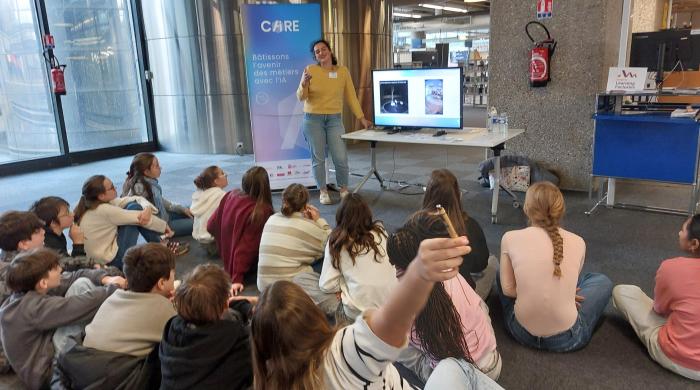
External outreach is also underway. We have a credible continuing education program that is beginning to take shape. This year, in particular, we organized a "Lean Manufacturing" training day for SMEs in the region in collaboration with the Lean Institute France.
We are also developing the scientific component through research. Ana Sofia will begin her first thesis this year on Lean approaches in the context of Industry 5.0. The thesis will be supported by LISPEN and co-supervised by the Lille and Aix-En-Provence campuses.