
A professor and researcher in Angers, Amine Ammar has been in Singapore since September 1 as part of the DesCartes program.
What is your mission in Singapore?
I am participating in the DesCartes program, which is run by the CNRS subsidiary in Singapore (more information) and involves the CNRS, several French institutions including Arts et Métiers, several Singaporean universities, and several industrial partners (CETIM, ESI Group, THALES, etc.). A team of 80 French researchers and 80 Singaporean researchers are working on this program. Funding is provided by the Singapore government and the CNRS. Its scientific coordinator is Francisco Chinesta, a professor specializing in computational mechanics and artificial intelligence at PIMM (more information).
DesCartes is developing hybrid AI methods to enable real-time decision-making in response to complex situations related to critical urban systems. This research will be applied to urban mobility, energy management, and anticipating the needs of future transportation networks, industries, and smart buildings.
What projects are you working on specifically?
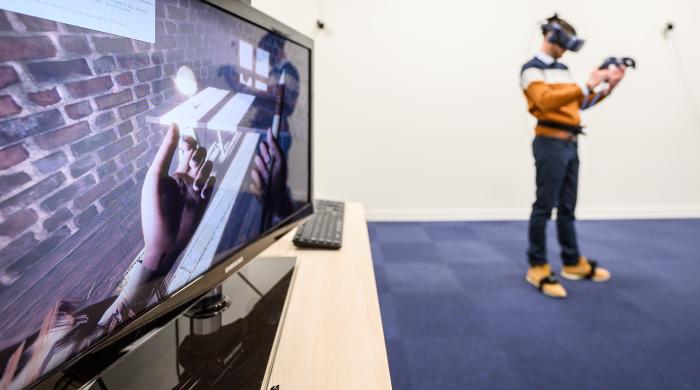
I am contributing to a Work Package focused on developing demonstrators for drone navigation in urban environments, as well as for the detection of defective areas through imaging and the identification of their thermomechanical properties.
The first demonstrator simulates the effect of wind on drones in the city and explores how to control their speed locally; the second demonstrator focuses on the corrosion and deformation of pipelines. Other initiatives are also being implemented.
In this context, I supervise a team of four postdocs and Master of Science students.
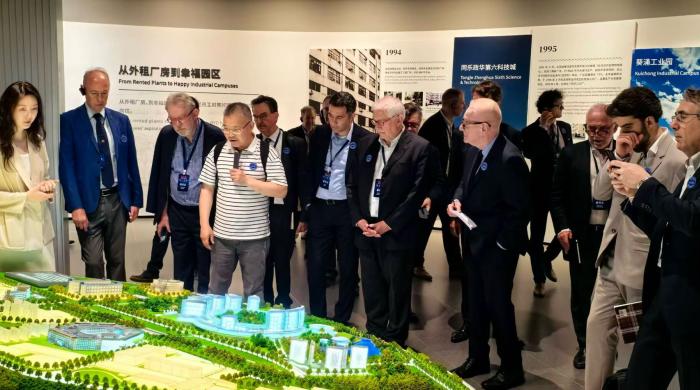
We presented the initial results of our work with Francisco Chinesta at the event organized for the first anniversary of the DesCartes project.
What does this experience bring you?
It's very rewarding because I get to meet other researchers (CNRS or EC) who are also working abroad. We share new knowledge, particularly in mathematics and AI.
And I have a comfortable working environment because I don't teach as part of my CNRS assignment, which means I can focus on my research activities.
What's more, life in Singapore is very pleasant. It is a multicultural city where you meet Malays, Indians, Chinese, Europeans, and Americans in an atmosphere of mutual respect. Life is very safe: trust in others is a shared value.
Moreover, more than just a plus on my resume, this international experience will be an unforgettable moment in my career.