Buying only the edible part of a pineapple and reducing musculoskeletal disorders among workers using an automatic fruit-extraction machine—that’s the challenge taken on by a second-year student from Angers enrolled in the Entrepreneurship and Technological Innovation (PEIT) track of Grande Ecole Engineering Programme. We sit down with Levon Margarian, who tells us about his project and his entrepreneurial spirit!
A student in Industrial Product Design (CPI) at Chevrollier High School in Angers, Levon Margarian is working on an end-of-year educational project involving a pineapple extraction machine. Initially intended for educational purposes, Levon became so interested in the project that he decided to industrialize the machine, which will be automated and thus reduce repetitive strain injuries. Once he had his diploma in hand, which he obtained with flying colors as Levon ranked first in the Nantes academy with an average of 17.43 out of 20, his entry into Arts et Métiers allowed Arts et Métiers to continue his project and boost his entrepreneurial spirit!
A machine that reduces musculoskeletal disorders
Designing a pineapple extraction machine... nothing surprising there, but designing an automatic pineapple extraction machine is not as easy as it seems! "What is innovative about the design of this automatic machine is the ejector blade system, which extracts the fruit and discards the skin and core in a single movement," explains Levon. Today, some machines can extract the fruit, but the preparer still has to perform several operations, such as removing the core and skin. "Our automatic pineapple extraction machine will reduce musculoskeletal disorders (MSDs) by reducing the number of tasks to be performed by the operator," adds Levon. Proof of this can be found at Hyper U in Mûrs-Erigné , where he began testing his project. In this supermarket, each operator extracts 80 pineapples per day by hand and 160 pineapples per day on weekends. "They exceed ergonomic standards, so our automatic machine will eliminate MSDs because the pickers will not have to exert any force to cut the pineapples!"
From 3D design to machine manufacturing
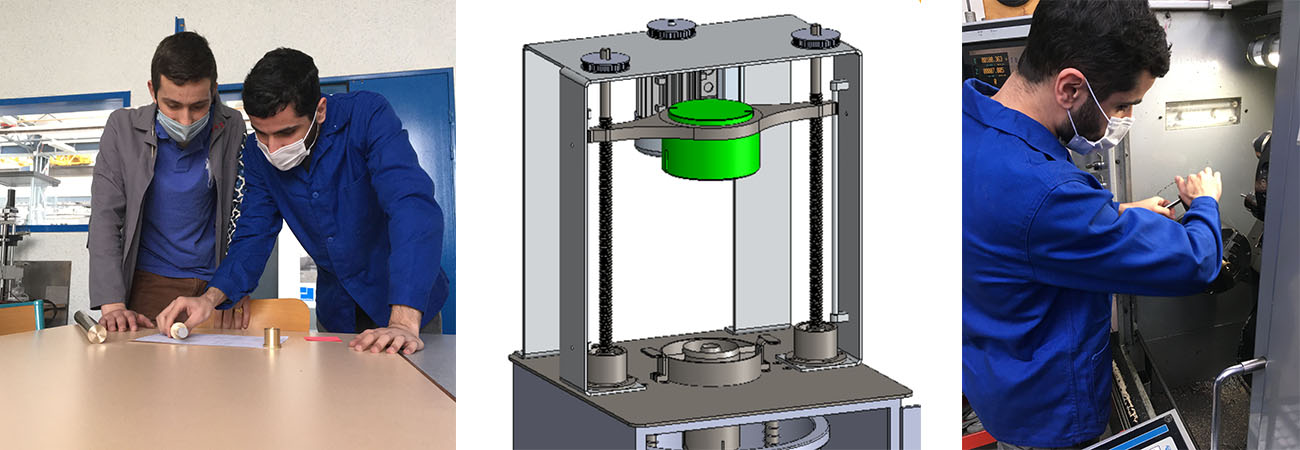
After completing the 3D design of the automatic pineapple extraction machine, the challenge is to create a prototype to assess the feasibility of marketing it. To achieve this, Levon Margarian teamed up with one of his classmates, Godefroy Le Clerc de Bussy. " It's a real bonus because we organize ourselves together, we trust each other, and we help each other out. It's real teamwork!" says Levon.
After manufacturing the prototype, testing will begin shortly. The aim of this stage is to verify that it is indeed possible to extract the edible part from the inedible part, validate the specifications before committing, and finalize the market study. The prototype will then be loaned on a priority basis to the Hyper U supermarket in Mûrs-Erigné to test it with operators and adapt the machine if necessary.
And what happens next…
To give himself the best chance of success and take his business creation project further, Levon Margarian, after benefiting from valuable advice during his Entrepreneurship and Technological Innovation (PEIT) program, will join CREDA in his final year.